I like how pleasant people are to each other here. When I say this, I mean the formalities that they assume when conversing or addressing one another.
Of course, as a teacher, my students will call me "teacher" quite often and not by my name. At first, this was irritating because I thought that the students didn't remember my name, so they just called me "teacher" instead. Later, however, I was informed by another teacher that this was actually a sign of respect; if a student calls you by your name, it means they see you as an equal, which is actually a little rude since respect for the teacher is common in this culture. Perhaps it is a bit haughty of me, but I get a little irritated now when a student calls me by my name, because I know this and I am used to being called "teacher".
Sometimes, although less common, a student who is particularly polite or respectful will call you "hoca" (hodja). This is an old word that was commonly used as a respectful term for a religious teacher, but nowadays people use it as a term of respect for any type of teacher. Personally, I like being called "hoca"; it makes me feel more important or older than I really am.
There is an entirely different set of words for people older or who should be respected. For example, for older women you know that you work with or live near, you have to call them abla (abla espanol?), which means "older sister". If there is an older man who helps you or who you respect, you can call him amca ( am-jah, paternal uncle) or dayır (maternal uncle). If you don't know someone well and want to be particularly formal you can call them Efendim, Sir or Madam, but this word has different meanings depending on the context:
a) If you want to call someone Sir or Madam, you say Efendim.
b) If you answer the phone, you must say, "Efendim?"
c) If someone calls your name, you can say, "Efendim?", like "Yes?"
d) And, of course, if you didn't hear what someone said, you can say "Efendim?" - Pardon?
The most common, and friendly, forms of address between men (different world for women, I don't know) however are ağa bey and kardeş. Ağa bey (aaah bay) means "older brother", and is a common form of address between people you are both friendly and unfriendly with and is used very often: "What's that ağa bey?"; "Sorry, ağa bey."; "Where are you, ağa bey?" and so forth. It's almost mandatory at the end of the sentence sometimes. Usually people who are older than you, the same age as you, or younger than you but you respect are ağa bey. Kardeş (younger brother) serves the same function, but is used only for people who are younger than you.
An then, of course, the chummier varieties of address abound: dostum (buddy), arkadaşım (my friend), kanka (pal), and lan (dude) are all common between friends.
Of course since these terms of respect and friendship abound, so do the greetings and personal inquiries. One of the things I like about Turkish people is that, like Americans, they ask you how you are doing. This is in contrast to Europeans, who don't care how you are and see the question as a superficiality. But of course when you meet someone, in Turkish, there is a slue of greetings all at once: "Merhaba! Nasılsın? İyiyim? Ne haber? Ne yapıyorsun?" (Hello! How are you? Good? What's news? What are you doing?) and so on.
Naturally this can be quite much after a while, but it is endearing nonetheless. The funniest thing about this, in my opinion, is that "Thank you" is an acceptable response to all these greetings. So naturally, one of the hardest parts about teaching Turkish students is teaching them not to say simply "thank you" when someone asks, "How are you?"
Thursday, May 27, 2010
Thursday, May 13, 2010
An Interlude
The weather was wretchedly hot and the sun unnecessarily oppressive. Even though my apartment was cool and shady, I was bored and itched to get out. The monotone buzzing of a solitary black fly that had gotten trapped in my abode exascerbated this feeling - the hopeless boredom of a hoplessly hot day. I grabbed my camera because, as you know dear readers, I have pathetically little photographic evidence to show for the amount of time I have been here, and stepped out into my sunny alley.
I walked down to the pedestrian bridge that overpasses the tram station and the highway to see if I could get a decent photo; on some clear days, you can see the Asian side from the bridge, but since it was hot and hazy, and the trees had acquired significantly more foliage since the last time I admired the view, Asia was now nothing more than a blurry hump in the distance.

Anatolia, in the distance

Fındıkzade

Cerrapaşa
On a similar trip about a month ago to this park with Christine, I saw people on top of these old city walls, playing on them, drinking beer, loafing. I wanted to have a little adventure and explore the wall ruins, which are remarkably intact, and unrestricted to the public.

The ruins of Constantinople

Gypsy paradise
Yet despite all of the filth and trash, there was a certain beauty about these ruins from a faded past. Outside, they evoked the romantic nostalgia of another age, and pretty little yellow and white and purple flowers sprang from the cracks and seams in the stones. A gnarly tree's red berries beautifully contrasted its deep green leaves and the faded siena of the old wall.


A shortcut to the sea


A good way to spend the day

As I returned to the stairs to descend, I saw a police officer across the highway pacing aimlessly and flushed momentarily; however, I quickly remembered that I wasn't in America anymore. The police here aren't nosy and killers of fun like they are back home - no "Hey, get down off that cultural monument!" here. They could care less. This fact was indeed confirmed as I climbed off the bottom of the stairs and jumped to the ground; as soon as I had come off the wall, I heard a broad, flat crunch and looked up to the highway to see that two cars had smacked hard into each other. As the two drivers got out and argued angrily, the traffic policemen sauntered over ambivalently, unhurriedly. I feel you man - too hot to hurry.
I decided to head back up the hill at this point to seek some shade. I was sticky and soaked by the time I got back up the hill, and decided to seek the cool shade and fountains of cold water from the neighborhood mosque courtyard.

The Ali Paşa Hekimoğlu mosque
Of all the mosques I have seen here, this mosque, the Ali Paşa Hekimoğlu mosque, is by far my favorite and in my opinion the most beautiful. The courtyard, shaded by tall broad pine trees,
is wide and extremely well kept, with pretty colorful flowers bordering the impossibly green grass. It also houses some small cemetaries as well as the tomb of Ali Paşa Hekimoğlu (whom I admittedly know nothing about, but the marble plaque on the wall of his tomb says he was an awesome man). There is also a large marble cistern filled with clean, clear water for ablutions, and a vined trellis under which tired old men pass their days. The most incredible thing about this courtyard is that it is so quiet and peaceful despite it being olny a few yards away from a busy street and intersection.

Glorious shade

A good way to cool off
Now when I first moved to Fındıkzade I - unsurprisingly, since there are over 3,000 in this city - didn't think much of this mosque, that it was just another of many. However, while looking in a book at the book bazaar a few weeks earlier, I saw a picture of this particular mosque and was taken aback by its beauty. Luckily it was open, so I took off my shoes and stepped inside. The book - and Chrissy - were right. The high white ceilings of the domes were beautifully embellished by hand-painted flowery Quranic excerpts. Hairline cracks in the plaster testified to the mosque's age. The windows were decorated in the most beautiful fashion with blue, red, and green stained glass, and brilliantly transformed the sunlight shining through. Unfortunately, I only had a few moments to absorb the architectural beauty inside, and a man was locking the mosque up until the next prayer time. As I put my shoes on and meandered in the courtyard, I admired the intricacy of the carved marble. Funny, I thought, that when someone put these stones here, our homes were still wilderness. Along the side of the mosques, some students were also studying the architecture, but in a more profane way. As I walked through the courtyard arches to leave, I noticed the stone turbans and epitaphs of broken headstones lined along the low wall of the cemetary. Staring at the Ottoman script on the stones, I wondered who these people were, or even if this final legacy of theirs could even be understood, as Ottoman Turkish is no longer spoken and is on its way to being a dead language.

Hot weather, cool marble

I'm sure that was no easy task


Gone and forgotten?
Tuesday, April 27, 2010
Culture, anyone?
What do you think of when you think of Turkey, my friends? Perhaps you think of faded aged, rugs, kebabs, the sweet licorice-like scent of nargile smoke, the sharp minarets of mosques abruptly interrupting the skyline and their azans tiredly punctuating daily life. Perhaps you think of the paradox of bearded, turbaned men and headscarved women contrasted by the seductive oriental fables of sultans' gluttony and harem fantasies. Perhaps, like myself before I came here, you don't really know what to think about Turkey at all, on second thought.
It's one of the most profound, and deeply irritating, questions of the postmodern era, namely because no one can come to an agreement on it: what is culture, and what is identity? Thousands have passed their lives buggered by the question, and once you think you've got it, someone comes along and says, ''No, no! Wrong! It's more like.....'' It is further complicated by the multiplicity of cultures in the modern world and, even further by subcultures and identities......my what a mess liberal thought has made of soceities. The silliest thing about it all is that people actually have time to concern themselves with matters such as these. Imagine if people put the same amount of time and thought into things such as ''How can we get water to that village over there?'' or ''Well, how can we get those swindlers on Wall Street to stop buggering up everyone's lives?'' But now I'm rambling, excuse me.
Regardless, it is natural for a product of the Western education system to ponder matters such as these, no matter how ultimately unimportant they may be. Of course,as an American doint a stint in İstanbul, I have of course been asking the culture question - of Turks and myself:
What is Turkish culture? What is culture?
Good question, and naturally everyone has something to say about it. I try to be as open minded as I can, especially when I travel. Not an easy task, but I think I can score some points for trying. When I came here, I honestly admit I didn't know that much about Turkey. It's easy enough to imagine American culture - gunslinging cowboys, Coke, Hollywood and such - but what about Turkey? Well, I know they are muslim there. They eat a lot of grilled meat, and I hear they like to drink tea. It's probably hot, a lot of sun. And I'm pretty damn sure they don't speak Arabic there. So when I got here, I was pleasantly surprised by many things - the people are friendly, and the food is good. Everyone is clean, not too conservatively religious, and the language is pretty simple. Anti-American sentiment isn't too strong, and surprisingly, a lot of the time I feel like I'm living in the middle of Europe, sans stuffiness of course. But wait a second - isn't this a muslim country? Indeed it is, and the paradoxes are quotidian; stare at the big-breasted sunglasses advertisement while waiting for the ancient bus and hear the azan drill your eardrums out. Watch the headscarved girls wearing Converse high tops and Gucci bags walk by.
Arabesque music from one car blasting by, Rhianna from the next. So which is it, you ask yourself, what's the culture here?
I'm sure I'm not the first idiot to ask that question, and I sure as hell won't be the last. To be honest, I really don't think I'm in any kind of position to make an educated guess about it seeing as how I have only been here for a few months, anyway. So I ask my freinds and students: does Turkey have its own culture?
Surprisingly, most of them say no, no it doesn't. Why not? Well, think about the history here chummy: first, there were the shamanistic Turkic tribes. The the Greeks came with their polytheism, followed not too long after by the Romans. Soon they evolved into the Christian Byzantines, who were ousted by the Ottoman Turks, the warriors of Islam. They had a good run at it, but eventually even they were done away with by Atatürk, who founded the modern Turkish republic based on the western model because of a personal distaste for all things Ottoman - the old Arabic abjad was replaced by the Latin alphabet, suits replaced traditional garb, and in general everything European was forced into fashion. So you see, how can we have our own culture since the cultures of others have been battling for supremacy here for the past 2500 years? A valid point indeed, especially when you think about it; can't the images of dim brass lanterns and carpets and harems be traced back to the near east, and those of flashy sneakers and cell phones be traced to the West? The sole unique thing about it just may be the language - it's completely unrelated to any European or Semitic language which surrounds it (despite having acquired a great deal of loan words from Arabic). Perhaps it is not so much that they don't have their own culture as they haven't had the chance to create one.
Well, be that as it may, most Turkish people are proud of their culture and identity, and they should be. Even if it is a product of historical mish-mash, it is rich and colorful. Recently, I had a discussion about this with a more advanced student. Turkey may not have its own culture, but it has strong traditions, and isn't that a good part of culture? American culture is weak in comparison, he claimed. I certainly begged to differ on that point, but regardless in the end, I was left pondering: which is worse? To have a weak culture, or to have yours borrowed from another?
I'm sorry. I suppose by now I could have gotten water to that lone village.
It's one of the most profound, and deeply irritating, questions of the postmodern era, namely because no one can come to an agreement on it: what is culture, and what is identity? Thousands have passed their lives buggered by the question, and once you think you've got it, someone comes along and says, ''No, no! Wrong! It's more like.....'' It is further complicated by the multiplicity of cultures in the modern world and, even further by subcultures and identities......my what a mess liberal thought has made of soceities. The silliest thing about it all is that people actually have time to concern themselves with matters such as these. Imagine if people put the same amount of time and thought into things such as ''How can we get water to that village over there?'' or ''Well, how can we get those swindlers on Wall Street to stop buggering up everyone's lives?'' But now I'm rambling, excuse me.
Regardless, it is natural for a product of the Western education system to ponder matters such as these, no matter how ultimately unimportant they may be. Of course,as an American doint a stint in İstanbul, I have of course been asking the culture question - of Turks and myself:
What is Turkish culture? What is culture?
Good question, and naturally everyone has something to say about it. I try to be as open minded as I can, especially when I travel. Not an easy task, but I think I can score some points for trying. When I came here, I honestly admit I didn't know that much about Turkey. It's easy enough to imagine American culture - gunslinging cowboys, Coke, Hollywood and such - but what about Turkey? Well, I know they are muslim there. They eat a lot of grilled meat, and I hear they like to drink tea. It's probably hot, a lot of sun. And I'm pretty damn sure they don't speak Arabic there. So when I got here, I was pleasantly surprised by many things - the people are friendly, and the food is good. Everyone is clean, not too conservatively religious, and the language is pretty simple. Anti-American sentiment isn't too strong, and surprisingly, a lot of the time I feel like I'm living in the middle of Europe, sans stuffiness of course. But wait a second - isn't this a muslim country? Indeed it is, and the paradoxes are quotidian; stare at the big-breasted sunglasses advertisement while waiting for the ancient bus and hear the azan drill your eardrums out. Watch the headscarved girls wearing Converse high tops and Gucci bags walk by.
Arabesque music from one car blasting by, Rhianna from the next. So which is it, you ask yourself, what's the culture here?
I'm sure I'm not the first idiot to ask that question, and I sure as hell won't be the last. To be honest, I really don't think I'm in any kind of position to make an educated guess about it seeing as how I have only been here for a few months, anyway. So I ask my freinds and students: does Turkey have its own culture?
Surprisingly, most of them say no, no it doesn't. Why not? Well, think about the history here chummy: first, there were the shamanistic Turkic tribes. The the Greeks came with their polytheism, followed not too long after by the Romans. Soon they evolved into the Christian Byzantines, who were ousted by the Ottoman Turks, the warriors of Islam. They had a good run at it, but eventually even they were done away with by Atatürk, who founded the modern Turkish republic based on the western model because of a personal distaste for all things Ottoman - the old Arabic abjad was replaced by the Latin alphabet, suits replaced traditional garb, and in general everything European was forced into fashion. So you see, how can we have our own culture since the cultures of others have been battling for supremacy here for the past 2500 years? A valid point indeed, especially when you think about it; can't the images of dim brass lanterns and carpets and harems be traced back to the near east, and those of flashy sneakers and cell phones be traced to the West? The sole unique thing about it just may be the language - it's completely unrelated to any European or Semitic language which surrounds it (despite having acquired a great deal of loan words from Arabic). Perhaps it is not so much that they don't have their own culture as they haven't had the chance to create one.
Well, be that as it may, most Turkish people are proud of their culture and identity, and they should be. Even if it is a product of historical mish-mash, it is rich and colorful. Recently, I had a discussion about this with a more advanced student. Turkey may not have its own culture, but it has strong traditions, and isn't that a good part of culture? American culture is weak in comparison, he claimed. I certainly begged to differ on that point, but regardless in the end, I was left pondering: which is worse? To have a weak culture, or to have yours borrowed from another?
I'm sorry. I suppose by now I could have gotten water to that lone village.
Sunday, April 18, 2010
The Busy Rhythym
Again dear followers of this blog, I am sorry for not keeping it up as I should. I know many of you check here often to no avail. But I have good reason! I hadn't had the time because I had been so busy, what with my time slpit between work and spending time with Christine since she was here. She stayed here for the better part of a month and we had a wonderful time, cooking, exploring, loafing, smoking nargile, enjoying the city.
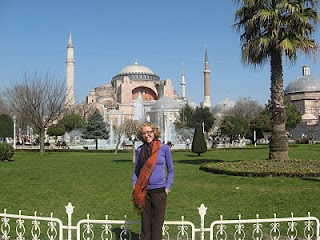
I explored a lot of İstanbul with her that I hadn't seen for the time that I had been here. I played tour guide for a little while while I lived in Sultanahmet: the Blue Mosque, Eminönü, the Grand Bazaar, the Spice Bazaar, the nargileci tucked behind mosques that felt like stepping back into the Ottoman days of the 1600s when you went inside. She explored a lot of the museums and such herself though while I was working in order to keep busy, so I am apparantly still missing out on a lot of good stuff. We did make it to the Archaeological Museum together, but I wish it had been another museum we had gone to; let's just say this prospective visitors - don't come here just to see the archaeology museum. At times it was like the Greek section of the Met.
One day, when the weather was halfway decent, we went up in the Galata Tower, which is across the Golden Horn from where I live. It is a stone tower built in the 7th century by the Byzantines that functioned as a lighthouse, a fire tower, and a prison at various times, but nowadays it houses a restaurant/nightclub and a narrow balcony where tourists can go out and view the cityscape and the Bosphorous. Since it is on a hill it does indeed provide an excellent view of the city and you are actually higher up than you think you really are. Legend has it that around the 14th century, one man fashioned some wings made from fabric, jumped off the tower, and glided to the other side of the Bosphorous while the sultan and thousands of people looked on. At first, the sultan was pleased, but on second thought he had the man put to death because he feared he may have been some sort of magician or sorcerer.
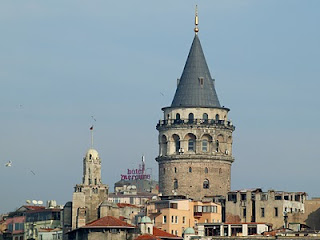
The view from the top really is breathtaking; on the day we went up you could see clear for fifteen or twenty miles, and apart from the sea and the mountains across it, all there was to see to the horizon was city. İstanbul. You don't really know how big the city truly is until you go up in the tower and see it stretching to the horizon. New York built up, but İstanbul built out. Indeed, you could say that İstanbul is no more than a collection of villages. Many parts of the city actually still retain their village names: Bakırköy (Copper Village), Karaköy (Black Village), Arnavutköy (Albanian Village), Yeşilköy (Green Village), and so on. You really get a sense that İstanbul really is too big for one continent when you are up on the balcony of the tower, looking over the terra cotta roofs with the salty wind blowing in your face and the sound of ships' horns belching in the distance.
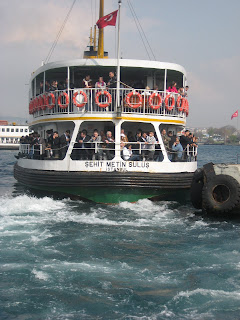
Another day we took the ferry to Kadıköy, on the Asian side. The ferry boat is the same fare as riding the bus or the metro, so it is an inexpensive activity for the student or budget traveler. Like the Staten Island ferry, everyone waits in the terminal until the arriving passengers get off the boat, and then once the doors open everyone throngs toward the entrance and you get squeezed like a tube of toothpaste. On the boat we clambered across the rickety wooden gangplank and climbed over the massive piles of ropes and got a seat along the rear starboard gunwale toward the stern. On the way over a thick salty haze over the water made it difficult to see to far, but the deep, cold water was a brilliant blue green color, and sparkled in the weak sunshine.
The Asian side of İstanbul was pointedly less crowded, more laid back and relaxed. People didn't have the urgent hustle of the European side, and the energy was much more easygoing and welcoming. Since we went in the late afternoon, we didn't stay long, just long enough to get a feel for ''The Other Side'' and to catch a few cups of tea, a nargile, and a balık ekmek (fresh mackerel sandwich). On the way back, the setting sun bathed the city in an orange glow, and as the temperature dropped rapidly as we crossed the Bosphorous our puffs of breath mixed with the salty haze over the water. The other side was nice, but I was glad to be back in Europe - back in the busy rhythym. As the boat moved in place to dock, people began climbing over the rails and leaping onto the dock before the boat was even close to being tied up. I laughed and enjoyed the romance of it - it was quite the contrast to back home, where insurance and safety regulations take the fun out of everything. People do still live in some places.
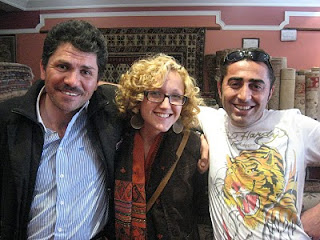
Aside from exploring and running around, going to the gym and hanging out in parks and exploring mosques and cooking and olive-tasting at bazaars, Chrissy made some friends as well. Well, more like she stole my friends from me (wink). Her abundant free time allowed her to spend more time with my friends than I could, and she was well liked by all of them, probably more than I. They gave her countless cups of tea and great conversations and stories, and they were all sad when she left. My friends Kürşad and Üskan had a particularly fun time with her, jocularly joking her with and trying to get her to go home with a carpet, a small Afghan horse-hair carpet that I actually really liked and kind of wish she bought (wink again).

The 15 lira dinner
 Quite the keyboard indeed
I explored a lot of İstanbul with her that I hadn't seen for the time that I had been here. I played tour guide for a little while while I lived in Sultanahmet: the Blue Mosque, Eminönü, the Grand Bazaar, the Spice Bazaar, the nargileci tucked behind mosques that felt like stepping back into the Ottoman days of the 1600s when you went inside. She explored a lot of the museums and such herself though while I was working in order to keep busy, so I am apparantly still missing out on a lot of good stuff. We did make it to the Archaeological Museum together, but I wish it had been another museum we had gone to; let's just say this prospective visitors - don't come here just to see the archaeology museum. At times it was like the Greek section of the Met.
One day, when the weather was halfway decent, we went up in the Galata Tower, which is across the Golden Horn from where I live. It is a stone tower built in the 7th century by the Byzantines that functioned as a lighthouse, a fire tower, and a prison at various times, but nowadays it houses a restaurant/nightclub and a narrow balcony where tourists can go out and view the cityscape and the Bosphorous. Since it is on a hill it does indeed provide an excellent view of the city and you are actually higher up than you think you really are. Legend has it that around the 14th century, one man fashioned some wings made from fabric, jumped off the tower, and glided to the other side of the Bosphorous while the sultan and thousands of people looked on. At first, the sultan was pleased, but on second thought he had the man put to death because he feared he may have been some sort of magician or sorcerer.
The view from the top really is breathtaking; on the day we went up you could see clear for fifteen or twenty miles, and apart from the sea and the mountains across it, all there was to see to the horizon was city. İstanbul. You don't really know how big the city truly is until you go up in the tower and see it stretching to the horizon. New York built up, but İstanbul built out. Indeed, you could say that İstanbul is no more than a collection of villages. Many parts of the city actually still retain their village names: Bakırköy (Copper Village), Karaköy (Black Village), Arnavutköy (Albanian Village), Yeşilköy (Green Village), and so on. You really get a sense that İstanbul really is too big for one continent when you are up on the balcony of the tower, looking over the terra cotta roofs with the salty wind blowing in your face and the sound of ships' horns belching in the distance.
Another day we took the ferry to Kadıköy, on the Asian side. The ferry boat is the same fare as riding the bus or the metro, so it is an inexpensive activity for the student or budget traveler. Like the Staten Island ferry, everyone waits in the terminal until the arriving passengers get off the boat, and then once the doors open everyone throngs toward the entrance and you get squeezed like a tube of toothpaste. On the boat we clambered across the rickety wooden gangplank and climbed over the massive piles of ropes and got a seat along the rear starboard gunwale toward the stern. On the way over a thick salty haze over the water made it difficult to see to far, but the deep, cold water was a brilliant blue green color, and sparkled in the weak sunshine.
The Asian side of İstanbul was pointedly less crowded, more laid back and relaxed. People didn't have the urgent hustle of the European side, and the energy was much more easygoing and welcoming. Since we went in the late afternoon, we didn't stay long, just long enough to get a feel for ''The Other Side'' and to catch a few cups of tea, a nargile, and a balık ekmek (fresh mackerel sandwich). On the way back, the setting sun bathed the city in an orange glow, and as the temperature dropped rapidly as we crossed the Bosphorous our puffs of breath mixed with the salty haze over the water. The other side was nice, but I was glad to be back in Europe - back in the busy rhythym. As the boat moved in place to dock, people began climbing over the rails and leaping onto the dock before the boat was even close to being tied up. I laughed and enjoyed the romance of it - it was quite the contrast to back home, where insurance and safety regulations take the fun out of everything. People do still live in some places.
Aside from exploring and running around, going to the gym and hanging out in parks and exploring mosques and cooking and olive-tasting at bazaars, Chrissy made some friends as well. Well, more like she stole my friends from me (wink). Her abundant free time allowed her to spend more time with my friends than I could, and she was well liked by all of them, probably more than I. They gave her countless cups of tea and great conversations and stories, and they were all sad when she left. My friends Kürşad and Üskan had a particularly fun time with her, jocularly joking her with and trying to get her to go home with a carpet, a small Afghan horse-hair carpet that I actually really liked and kind of wish she bought (wink again).
A man's woman

The 15 lira dinner
We did so much and had the best time together, and it was too soon for her to leave; there was still so much to be done. It felt like she had been here with me all along, and now after she has gone my new house, which she moved into with me, is emptier and lonlier, because she made it homey with me. In many ways, it isn't, and won't be, the same.
Nontheless, changes at work coincided with her leaving. One teacher, who went on vacation, decided not to come back, and with another teacher being fired, things have been hectic around the school trying to get the teacherless classes covered. So now I am very busy covering classes, and I don't have much time for anything else - forty hour weeks with Wednesdays off for the time being. It's good because it is keeping me busy, and the exhaustion will be worth it in the end.
But the busy rhythym has been lightened by one thing: I bought a new typewriter for my collection. I haggled with the old keymaker and got it down to 65 lira ($50), and what conditioın it is in. A Turkish Typewriter!!
Mom, make some more room in the attic!!
 Quite the keyboard indeed
Wednesday, March 31, 2010
Fındıkzade
The weather was cold and rainy as I left Sultanahmet. My scrawny shoulders and arms labored under the weight of my packed belongings; I foolishly wore a winter coat which made me sweat profusely as I toiled up the hill, burdened. I should have taken a taxi to avoid the neighborhood gawkers that regularly accost me on my walks to and from my former home - they were out despite the rain. One, the one who I am convinced stands on the street all day solely waiting for me to pass by, was nice enough to help me with our bags, but he pestered me along the way with questions about where I was going, when I would come back, etc. (and how much, of course).
Getting on the crowded, stuffy humid tram straining under the weight of my bags, however, I breathed a sigh of relief: I don't have to come back here anymore. I don't have to take back streets to avoid the hasslers. I don't have to indulge Turkish hospitality for the sake of an impromptu English lesson. I don't have to have loud Spaniards in my way. I don't have to freeze at the sound of the front door closing and shuffles in the hallway at night for fear it might be my (now ex) drunken landlord. I don't have to walk over coarse and uneven cobblestones up and down the hill to get to and from home. I don't have to ride the tram for an hour to get to and from work anymore.
The neighborhood of Fındıkzade in the district of Fatih, which I now call home, is quite the contrast from the stuffy pestering district of Sultanahmet. It is pointedly less crowded and laid back, and most certainly a family neighborhood, the kind where old headscarved grandmothers lower a basket on a string down from the fourth floor window for the neighborhood children to put bread and water from the corner shop in. It is closer to my work, which is a major relief, because it now only takes me about half an hour to get to work. Everything is inexpensive, and it is much quieter. The people are friendly, and no one bothers me.
Walking into my new apartment was literally a breath of fresh air. Fresh, cold air. It is the ground floor apartment, which means that it is set slightly below street level, and, therefore, always cooler than the rest of the building. This will be good for when the full force of the Turkish summer sun is at its strongest, however. There is no gas, which is good because I won't have to pay a steep gas bill. I set my bags down, and heaved a sigh of relief. Home, sweet home.

Room to unpack
My new apartment is twice the size of my old one, furnished, and I pay less money. The walls are painted a lovely pinkish-peach color; the aroma of fresh paint was still lingering. The furniture is relatively new and comfortable and not some worn, hideous lot of earthen-hued 70's or 80's junk, and the carpets are new and tasteful. Incandesant light bulbs hang naked from the ceilings in an art deco-ish fashion.
The bedroom is equipped with a dresser and an armoir (both of which my old house lacked) as well as a queen-sized bed. The roomy bedroom window faces the street, which means the curtains must be closed all the time, but at least a lot of light comes in, unlike my old bedroom, which was a windowless dungeon at the back of the apartment.
Alley view and a huge fridge to boot
The kitchen is delightful: a normal-sized refrigerator and a tiled countertop with a wide sink below a window gets a lot of air and light into the kitchen and makes it an enjoyable place to hang out. I need to get some chairs or stools to put in there. However, it lacks a stove - instead it has a squat blue propane tank with a burner on which you can place pots or pans to cook. Dishes line the cabinets and even though the cooking medium leaves something to be desired, there are plenty of pots and pans, so I can cook more than two dishes (although not at the same time).

Clean, roomy, and sunny
Down the hallway from the kitchen and bedroom on the left is the bathroom. The previous occupant left a strange vareity of plastic shelves and other unsavory items in the trash can which I promptly disposed of. Like all bathrooms in Turkey, it is a wet room, with the electric water-heated shower in the middle. When you shower, the whole bathroom gets wet, and when you are finished you have to squeegee all the water puddles to the drain. Unfortunately, this bathroom is devoid of a western toilet, much to my agitation, so the asian toilet (see an earlier post) in the corner is both the place where you (squat) do your business and also the drain for the shower. *Sigh* I suppose you can't have your cake and eat it too. It is a sizeable bathroom, but I am irked by the asian toilet and the toilet tank that constantly runs and sometimes overflows if you don't babysit the old and faulty float in the tank. I lay awake the other night pondering this particular plumbing problem - namely, to see if I could have a western toilet installed. But then, the shower drain would have to be reworked, and then you get into tile work and the like, so I concluded that, like every plumbing problem, you open a real can of worms when you dare to venture into that territory - the required work grows exponentially. I have my uncle Andrew to thank for helping teach me that.

That's going to be a bit hard to get used to...
My living room is the piece de resistance of my new abode. Wide, roomy, with a loveseat and a couch (trundle bed included), it even has.....wait for it.....a washing machine!!! Never has such a sight brought me such happiness. The living room looks out over a tiny garden - well, more of like a concrete patio with shelved walls in which various weeds are growing, but at any rate, it's a nice place to sit when the weather is nice and has room enough for several clotheslines on which I can hang my clothes to dry. There is no TV, but I am wondering whether I will relly need one with the garden and all. The garden is in kind of a bad way - moldy, mossy, scattered with cigarette butts and various other unwanted household items - but I am glad about that, because it will give me something to do in my spare time and will satisfy my handyman itch to do something with my hands. Hey, I poked around Laurel St. for so long, so I've been dying for a project like this. Hopefully, when all is said and done it will be a nice space to sit in and have kebap barbecues with friends.
We'll get this cleaned up in no time
The new house is indeed delightful and has great energy. It feels like the previous occupants were good, honest people, and I swear I can feel the residual energy of children in the apartment. The landlord is kind and friendly, and the building is quiet. The building is located at the end of a short alley off a quiet street and is near a primary school, so the only noise is the occasional cries and laughter of playing children and the simit seller who comes down the alley at 9 am - ''Simit simit simit simitçi simit simit...!!!'' who will pass you a simit through the window if you don't want to go outside.
At the street end of my alley about 30 yards away I have everything I need: Bim, a discount grocery store; an appliance sales/repair shop; a bakery; a butcher; a shop that sells laundry soaps and other household cleaning suppies; a drinking water supply store; a tea house; a döner shop; and, of course, a row of payphones. Everything within an arm's reach, and friendly and honest people to boot; no, no swindlers here. And, of course, I am a 5 minutes' walk from the tram station that takes me to and from work (and the rest of the city).
Of course, what would a move be without some problem? No change of location passes unhindered. Tuesday night, the second night in my apartment, Chrissy had been making good use of the washing machine late into the night. I got up to use the bathroom and heard copious amounts of water splashing onto the floor. What's this? Peering into the bathroom, I saw water flooding the floor from under the sink. Upon closer inspection, it appeared that the washing machine drainage hose emptied right into the bathroom floor. Hm, OK. I went into the living room and got my feet soaked; for some reason, water from the washing machine had overflowed and water was all over the floor in the living room - saturating the carpet, under the couch, everywhere. ''Good thing I have the ground floor apartment,'' I thought, shaking my head. I don't know why the water went everywhere, but I stayed up late into the night trying to sop up all the spilled water with my one towel. Hopefully that won't happen again, because I am very excited about this washing machine - I haven't done wash for weeks and I don't need it shitting the bed on me.

My problematic (?) washer
A great roommate, a great neighborhood, and a great living space. Everything is just. Right.

Friday, March 26, 2010
Spring Changes and the Character of Cobblestones
Beloved family, friends, and inconspicuous followers of this blog, I apologize; please forgive me for not keeping up this blog as I should. It is a bit difficult when the only access I have to a computer is at my work, which is about an hour away from my place of residence, and lately, whenever I have resolved to take the time to update, some unexpected task presents itself or I haven't the time because of prep work and various other things. Very sorry.
Well now. Spring is very much here in İstanbul. This past week the temperatures reached the upper 60s, and the middle of the days were actually quite hot. Little tufts of yellow and white have begun to manifest themselves on the bare tree branches, and vibrant patches of color have sprung up amongst the roadside grasses and park fringes (although the good workers of the İstanbul greater municipality might have some responsibility for the latter). The colors of the sea and sky and earth are shining brighter and bolder, and people seem to be happier.
But Spring isn't all sunshine and flowers and baby animals, as we all know. Of course, this Saturday we have to lose an hour from our clocks, which goes down poorly with everyone. And because of the warm weather, there are more tourists roaming about in my home patch of Sultanahmet. Which also means more, larger crowds and, inevitably, more hasslers. Of course I have become used to living and a tourist area and the hanucu have come to know me and know not to bother me anymore, but the spring seems to have brought a fresh crop of hasslers to the weathered cobblestones of the historical district. It's like the full-time guys called all their cousins: ''Hey brother no work, huh? Come to Sultanahmet with me and pester the yabancılar with me, it's easy and you get to work outside!''
Naturally the increase in pedestrian traffic makes it difficult to go anywhere - especially lately because of the strange sudden increase in the amount of Spanish and Italian travelers who are, to me, notorious for always being in the way, and also irritatingly very loud. Walking becomes not only an exercise for your legs and feet, but also a workout for your lower back because you have to keep twisting and turning to dodge oncoming pedestrian traffic and make room for other people. I think the crowded sidewalks are exascerbated by the fact that, unlike American sidewalks, the sidewalks in İstanbul (and Europe for that matter) are quite narrow, and if there isn't a car parked on the sidewalk that directs your stroll into the street, there is some guy selling an eclectic vareity of junk laid out on a blanket (make room for the pocket tissues, please).
Well, at any rate, all this business with the tourists and the hassling and lovely weather has made me realize that soon I need to pack my things and find a quieter neighborhood to live in, and one preferably closer to work - the hour commute each way has become wearisome. Plus, I think living out of the way would really improve my language skills, because it would force me not to use English as much - nothing like jumping off into the deep end for a real taste of the local culture.
Perhaps my new neighborhood streets and sidewalks will be paved, unlike Cankurtaran. This would most certainly be a welcome change for me. Belgian Block, as we say back home, or, cobblestones, are quite nice; despite small bits of garbage getting caught between them, they have a romantic aura about them and stir the imagination as to the history they've seen. An American tourist I was walking behind recently put it succinctly: ''But cobblestones have so much more character....''
True enough, but they sure are hard on the feet.

Well now. Spring is very much here in İstanbul. This past week the temperatures reached the upper 60s, and the middle of the days were actually quite hot. Little tufts of yellow and white have begun to manifest themselves on the bare tree branches, and vibrant patches of color have sprung up amongst the roadside grasses and park fringes (although the good workers of the İstanbul greater municipality might have some responsibility for the latter). The colors of the sea and sky and earth are shining brighter and bolder, and people seem to be happier.
But Spring isn't all sunshine and flowers and baby animals, as we all know. Of course, this Saturday we have to lose an hour from our clocks, which goes down poorly with everyone. And because of the warm weather, there are more tourists roaming about in my home patch of Sultanahmet. Which also means more, larger crowds and, inevitably, more hasslers. Of course I have become used to living and a tourist area and the hanucu have come to know me and know not to bother me anymore, but the spring seems to have brought a fresh crop of hasslers to the weathered cobblestones of the historical district. It's like the full-time guys called all their cousins: ''Hey brother no work, huh? Come to Sultanahmet with me and pester the yabancılar with me, it's easy and you get to work outside!''
Naturally the increase in pedestrian traffic makes it difficult to go anywhere - especially lately because of the strange sudden increase in the amount of Spanish and Italian travelers who are, to me, notorious for always being in the way, and also irritatingly very loud. Walking becomes not only an exercise for your legs and feet, but also a workout for your lower back because you have to keep twisting and turning to dodge oncoming pedestrian traffic and make room for other people. I think the crowded sidewalks are exascerbated by the fact that, unlike American sidewalks, the sidewalks in İstanbul (and Europe for that matter) are quite narrow, and if there isn't a car parked on the sidewalk that directs your stroll into the street, there is some guy selling an eclectic vareity of junk laid out on a blanket (make room for the pocket tissues, please).
Well, at any rate, all this business with the tourists and the hassling and lovely weather has made me realize that soon I need to pack my things and find a quieter neighborhood to live in, and one preferably closer to work - the hour commute each way has become wearisome. Plus, I think living out of the way would really improve my language skills, because it would force me not to use English as much - nothing like jumping off into the deep end for a real taste of the local culture.
Perhaps my new neighborhood streets and sidewalks will be paved, unlike Cankurtaran. This would most certainly be a welcome change for me. Belgian Block, as we say back home, or, cobblestones, are quite nice; despite small bits of garbage getting caught between them, they have a romantic aura about them and stir the imagination as to the history they've seen. An American tourist I was walking behind recently put it succinctly: ''But cobblestones have so much more character....''
True enough, but they sure are hard on the feet.
Wednesday, March 3, 2010
Get a Grip
You know what the worst thing about being an expat is? Being a sick expat. Being terribly ill in a place where you barely know the language is the stuff of nightmares.
I fell ill last Wednesday night. I met a friend at a cafe and going home afterwards, I felt more like I was being dragged by the tram than riding it. My whole body ached, especially my kidneys, and my stomach was killing me. I was exhausted. I went home and went right to bed.
I couldn't get up the next day. I called work and told them I wasn't coming, that they would have to get someone to cover for me. Ok, no problem. Thursday I stayed in bed, as well as Friday; school was less happy about me missing two days:
''You're sick? Why don't you see a doctor?'' Because I hate going to the doctor and it's going to cost me a fortune I don't have right now, and he's going to tell me to do what I am doing right now. ''Don't worry, I'll be there for my Saturday class,'' I said, because I knew they'd be really mad if I called at 6.30 Saturday morning and made them find someone to cover for me.
Saturday I forced myself to get up and go. My body didn't ache anymore, but my stomach was killing me. I went to work anyway. By the time my class was over at 1, I was feeling a little bit better. My colleages suggested that I may have a parasite, but thankfully this fear was later alleviated. I asked a retired doctor friend of mine what he thought and he said, ''Perhaps it is stress,'' Hm. But I don't think I'm stressed, and my stress stomach aches have never been like this before. However, I ate some mint drops he gave me and I felt a lot better. I felt normal again. Happy. Yes! I went home and watched some TV before going to bed.
I woke up early on Sunday for work. On the way to work, I got the cold sweat again and my stomach began to writhe in pain once more. I made it about 3/4 of the way through my 4 hour class before I gave in: ''I'm sorry, class is over for today, I'm very sick, I have to go home,'' and I walked out and went home. After a long tram ride home which I don't remember, I curled up in bed freezing, sweating, and doubled over in pain.
I slept uneasily and had those dreams you have when you are unbelieveably ill - colors flash before your eyes, the ground rotates in every direction, and mysterious people appear out of nowhere and begin talking to you. You think about unsolveable nonexistant problems and wonder how you will ever escape this terrible fantasy world, and when you awake you are more exhausted than when you fell asleep because your mind has joined your body in tormenting you and sapping you of your energy.
I awoke late the next morning drenched in sweat and grabbed my dictionary - F, G, I İ,İ,İ......aha! Influenza (n.) = grip. Grip. I finally got one. Damn. I called my friend Selo and told him to bring flu medicine, and then called my work to call out for yet another day. By the end of Monday, my fever had gone and I didn't ache but my stomach was in terrible pain. At the behest of my employer, and my intuition at this point, I resolved to go to the doctor the next morning.
I woke up early on Tueday, showered, and visited my friend Kürşad. Luckily there was a small public hospital right behind his carpet shop. Since I finally got my residence permit, I don't carry around my passport anymore, but this was not a good idea when one has to visit the hospital I found, because as a foreigner to be seen by the doctor they need to enter your passport number into the computer. It is impossible without it, a mohawked teen with grubby sneakers in reception told me. Luckily (I should have guessed by now, this is Turkey), Kürşad knew the doctor and we were able to sneak downstairs and slip into the examination room. The room was pink and the paint was peeling off the walls. The examination table was covered in a white cotton cloth and not paper. A bespectacled female doctor and a nurse sat at a desk with a huge ledger on it. They told me to sit and asked what was wrong with me. I told them, ''Grip.'' Hm. Lie down, pull your shirt up. Cold stethoscope. Sit up, lean forward, pull your shirt up. Cold stethoscope. Deep breath. Shirt down. Open wide. Lift your arm, keep this thermometer there. She and Kürşad rattled on in Turkish about something. Take the thermometer out.
''Aha! Tamam,'' she said, and pulled out a pad and began scribbling furiously. ''You must eat only boiled potatoes, bananas, and light yoğurt for a few days, rest, sleep, and then you can,'' Huh? She handed me a prescription and Kürşad shuttled me out of the office - ''Çok teşekkür ederim doktor effendim!''
''Well, what is it??'' I asked him. ''The grip?''
''Not. The food,'' he replied. The food? We went to the pharmacy and picked up the medicine - 10 lira, $8 - and we returned to the shop. Usta was waiting for us there. ''Tell him what's wrong with me so he can explain,'' I told Kürşad (because Usta's English is much better than his). Bubble bubble.....''Aha!'' Usta exclaimed. ''You don't have the flu. The reason you are so tired all the time is that your stomach is not used to the food here. Your stomach is trying to take vitamins and nutrients from the food you eat but it is not getting them, so all of your energy is being used up on this process. The doctor has told you to eat bananas and potatoes and such to stop your diarrhea. You have to rest for a few days, then you can go back to work.''
Food. It was the food that was killing me. All that delicious food. *Sigh*
Well, the medicine seems to be helping a little bit. My stomach doesn't hurt that much anymore, but it still does a little every now and then, and I am still quite tired a lot. Hopefully in a few days I will be tip-top again. I have ventured off of the bananas-and-potatoes path a little prematurely, with some success, but I still hope this will clean itself up soon because my work just dumped another class on me in the morning on Thursday/Friday, so if I don't get better soon, well, I'll just have to go back to the hospital.
At any rate I can't complain about the bill; usually the rate I learned for foreigners to be seen and diagnosed is about 75 TL ($60). Because of my friend's friend's friend, can you guess what the bill was? 15 lira - about $12.
Being sick here is bittersweet.
Tuesday, February 23, 2010
Safe and Sound
Contrary to what the international media say, Turkey is a very safe country. Sure, people get robbed and beat up sometimes, but where doesn't that happen? For the most part İstanbul is a very safe place to live and work, as a foreigner and a native. This, I think, has much to do with the high security and amount of police they have everywhere here.
For the average American, the amount of armed police officers you see walking around everyday would seem a bit strange. Yes, there are a lot of people here - about 20 million in İstanbul to be approximate - so it does seem fitting that there are so many police. Conspicuous police, I mean. There are just as many plain clothes as there are uniformed. If you want to get a good idea about this, go to the mosque on Fridays and watch the men who go to pray and you will see how many of them are packing heat under their leather jackets. Of course, this is for a residential district. In places where there are more people, like shopping districts and tourist areas, the guns get bigger and the army usually hangs around just to make sure there is no nonsense about the national treasures.
Private security for buildings, museums, car parks, mosques, shops, and the public transportation system is a veritable small army in itself that indeed rivals the police in numbers. There are two guards on every tram/train station and at least one on every tram/bus/train/boat in the city. It isn't uncommon to have your bag searched randomly when you go through the turnstile at the train station, although it doesn't happen often. And a few weeks ago when I went to a shopping center with my friends, we had to allow security to search the car before we could park in the garage, and then we had to go through a metal detector to go inside.
The police keep tight on the public order. For every public rally or demonstraiton in a square or street with 50 people or more, a large armored bus will come and a regiment of riot police in full gear will pour out and leer at the crowd from close by, ready for anything. Some of my liberal friends are probably *tsk*-ing in disgust right now, but actually, I don't mind; I kind of enjoy it. Sometimes the security can become an inconvenience, but I think it helps more than it hurts. I feel quite safe and I don't have to worry so much about some nutjob doing something stupid and killing people, or any thieves making off with my stuff. I don't mind submitting to a search if it helps keep things safe - I've got nothing to hide so I needn't worry. I don't like to talk about politics too much, but I think our fine country should take a lesson - we might all be a little safer back home if we made small sacrifices like this and ratcheted up the security a little.
However, you can't call this a police state. Despite Code 301 (by which one can be jailed for insulting the nation, the flag, or Atatürk) and the police raids you see on the evening news every night, there is a lot of freedom. Sometimes the police will bully people, but this doesn't happen so much anymore. A few years ago this was common, but not so much nowadays. Why? Because the government has to make nice and look civil for their bid to join the European Union. Hopefully they will never be accepted, because it would be a financial and demograpic disaster for this country and Europe, but despite the outcome the efforts have had a good effect I think. Even though corruption is still rampant and blatant, the police behave (allegedly) more civil and still maintain the public order,and free press has flowered immensely. Yes, it is a true democracy here, and perhaps a bit safer than ours.
And that's all I will ever say about politics in this blog.
For the average American, the amount of armed police officers you see walking around everyday would seem a bit strange. Yes, there are a lot of people here - about 20 million in İstanbul to be approximate - so it does seem fitting that there are so many police. Conspicuous police, I mean. There are just as many plain clothes as there are uniformed. If you want to get a good idea about this, go to the mosque on Fridays and watch the men who go to pray and you will see how many of them are packing heat under their leather jackets. Of course, this is for a residential district. In places where there are more people, like shopping districts and tourist areas, the guns get bigger and the army usually hangs around just to make sure there is no nonsense about the national treasures.
Private security for buildings, museums, car parks, mosques, shops, and the public transportation system is a veritable small army in itself that indeed rivals the police in numbers. There are two guards on every tram/train station and at least one on every tram/bus/train/boat in the city. It isn't uncommon to have your bag searched randomly when you go through the turnstile at the train station, although it doesn't happen often. And a few weeks ago when I went to a shopping center with my friends, we had to allow security to search the car before we could park in the garage, and then we had to go through a metal detector to go inside.
The police keep tight on the public order. For every public rally or demonstraiton in a square or street with 50 people or more, a large armored bus will come and a regiment of riot police in full gear will pour out and leer at the crowd from close by, ready for anything. Some of my liberal friends are probably *tsk*-ing in disgust right now, but actually, I don't mind; I kind of enjoy it. Sometimes the security can become an inconvenience, but I think it helps more than it hurts. I feel quite safe and I don't have to worry so much about some nutjob doing something stupid and killing people, or any thieves making off with my stuff. I don't mind submitting to a search if it helps keep things safe - I've got nothing to hide so I needn't worry. I don't like to talk about politics too much, but I think our fine country should take a lesson - we might all be a little safer back home if we made small sacrifices like this and ratcheted up the security a little.
However, you can't call this a police state. Despite Code 301 (by which one can be jailed for insulting the nation, the flag, or Atatürk) and the police raids you see on the evening news every night, there is a lot of freedom. Sometimes the police will bully people, but this doesn't happen so much anymore. A few years ago this was common, but not so much nowadays. Why? Because the government has to make nice and look civil for their bid to join the European Union. Hopefully they will never be accepted, because it would be a financial and demograpic disaster for this country and Europe, but despite the outcome the efforts have had a good effect I think. Even though corruption is still rampant and blatant, the police behave (allegedly) more civil and still maintain the public order,
And that's all I will ever say about politics in this blog.

Saturday, February 20, 2010
Azan
Five times a day, every day, the muezzin calls all the faithful to come to the mosque and pray. The call is called the azan in Turkish, but the azan itself must be called in the original Arabic: Allahu akbar, Allahu akbar, Allahu akbar, a'shaddu Allah and so on. Usually the muezzin tries his best to make this call as flowery as possible, singing it like a song and hitting a wide range of notes.
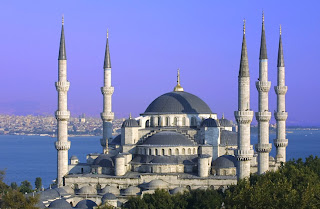
In the days of old, the muezzin would climb up to the top of the minaret, the mosque's accompanying tower, and cup his hands and call out the azan to call the faithful to prayer; this was the original purpose of the minaret. Over time, the number of minarets a mosque had came to symbolize the wealth and power of the sultan that built it - the more minarets, the richer and powerful the regime. Nowadays, however, because there are so many buildings and such to block the acoustics, large speakers are affixed to the top of the minaret and the muezzin simply has to turn the volume up and call the azan into a microphone. This occurs roughly at 6 am, 10.30, 12.30 pm, 3.30, and 7. Tourists and newcomers are enchanted by the beauty and haunting melody of the azan when they first hear it - indeed, it is quite lovely.
In many places in İstanbul, there is a mosque roughly on every block. So, in places like this when the azan is called, it transforms from a thing of charm and beauty into a hideous jarring cacophony: imagine 4 or 5 muezzins calling the azan at the exact same time with their speakers at top volume. Naturally, it is difficult for those who are trying to sleep in or have a telephone conversation at that particular moment. You'd think they would coordinate with each other: ''Hey brother, you want to call your azan at 12.15 and I'll do mine at 12.20, and we'll see if we can get Ali to do his at 12.25...what do you think?'' But this usually isn't the case. Sometimes, the azan from the Blue Mosque coordinates with the small ancient one across the park and it sounds as if they are calling back and forth to one another, which is lovely, but this doesn't happen often.
Now Fridays to Islam are what Sundays are to Christians, because the prophet's birthday happened to fall on a Friday. Therefore, at 12.30 on Fridays, everything slows down and those who usually don't go pray during the week pour into the mosque to humble themselves before Allah and beg forgivness for their human qualities. As for myself, I can't be sure if this is because they don't have time during the week, they just go the one time a week make themselves feel good, they really are pious, or because they get a sweet treat as they leave the mosque after the Friday 12.30 prayer.
Because I hang a lot on the streets during the daytime chatting and drinking tea, I often watch the faithful assemble before this prayer time. Usually on Fridays there are more people that come to pray than usual, so the mosque has to roll out carpets and prayer rugs on the sidewalk to accomodate the extra believers. It's quite a sight - tourists strolling by snapping photos while policemen and shopkeepers prostrate themselves. However, the amount of people varies from week to week. My friend Kürşad says that the amount of people praying is relevant to the amount of business during the previous week; the more people praying means that business has been bad, and the less means that business has been good. It sounds silly, but if you go around and talk to people, you will discover that this theory indeed holds water. Of course, because I am a cynic, I have cynical friends, but at any rate I can't bag on the pious too much; the people here are the most hospitible I've ever met and most of them are honest and kind. And since the first thing the Qur'an says is ''Be clean,'' and the pious wash themselves before every prayer, they are some of the cleanest people I have ever seen. They share everything with you should they become friendly with you, and ask nothing in return. But sometimes, I wish they wouldn't share some things. Like the azan at 6 am. So it goes, though.
In the days of old, the muezzin would climb up to the top of the minaret, the mosque's accompanying tower, and cup his hands and call out the azan to call the faithful to prayer; this was the original purpose of the minaret. Over time, the number of minarets a mosque had came to symbolize the wealth and power of the sultan that built it - the more minarets, the richer and powerful the regime. Nowadays, however, because there are so many buildings and such to block the acoustics, large speakers are affixed to the top of the minaret and the muezzin simply has to turn the volume up and call the azan into a microphone. This occurs roughly at 6 am, 10.30, 12.30 pm, 3.30, and 7. Tourists and newcomers are enchanted by the beauty and haunting melody of the azan when they first hear it - indeed, it is quite lovely.
In many places in İstanbul, there is a mosque roughly on every block. So, in places like this when the azan is called, it transforms from a thing of charm and beauty into a hideous jarring cacophony: imagine 4 or 5 muezzins calling the azan at the exact same time with their speakers at top volume. Naturally, it is difficult for those who are trying to sleep in or have a telephone conversation at that particular moment. You'd think they would coordinate with each other: ''Hey brother, you want to call your azan at 12.15 and I'll do mine at 12.20, and we'll see if we can get Ali to do his at 12.25...what do you think?'' But this usually isn't the case. Sometimes, the azan from the Blue Mosque coordinates with the small ancient one across the park and it sounds as if they are calling back and forth to one another, which is lovely, but this doesn't happen often.
Now Fridays to Islam are what Sundays are to Christians, because the prophet's birthday happened to fall on a Friday. Therefore, at 12.30 on Fridays, everything slows down and those who usually don't go pray during the week pour into the mosque to humble themselves before Allah and beg forgivness for their human qualities. As for myself, I can't be sure if this is because they don't have time during the week, they just go the one time a week make themselves feel good, they really are pious, or because they get a sweet treat as they leave the mosque after the Friday 12.30 prayer.
Because I hang a lot on the streets during the daytime chatting and drinking tea, I often watch the faithful assemble before this prayer time. Usually on Fridays there are more people that come to pray than usual, so the mosque has to roll out carpets and prayer rugs on the sidewalk to accomodate the extra believers. It's quite a sight - tourists strolling by snapping photos while policemen and shopkeepers prostrate themselves. However, the amount of people varies from week to week. My friend Kürşad says that the amount of people praying is relevant to the amount of business during the previous week; the more people praying means that business has been bad, and the less means that business has been good. It sounds silly, but if you go around and talk to people, you will discover that this theory indeed holds water. Of course, because I am a cynic, I have cynical friends, but at any rate I can't bag on the pious too much; the people here are the most hospitible I've ever met and most of them are honest and kind. And since the first thing the Qur'an says is ''Be clean,'' and the pious wash themselves before every prayer, they are some of the cleanest people I have ever seen. They share everything with you should they become friendly with you, and ask nothing in return. But sometimes, I wish they wouldn't share some things. Like the azan at 6 am. So it goes, though.
Monday, February 15, 2010
Sunday Afternoons
I love the level 1 beginner class that I teach. They are loads of fun. My students ages range from 17 to 33, but they all get along nicely and behave as if they've known each other for ages. The class is usually riotously fun - the students roar with laughter at my snide jokes and shameless use of my poor Turkish to help get an idea across or liven class up a bit. I think their excitement and enthusiasm has a little to do with the fact that they are new and enthusiastic abut learning and haven't yet encountered the horrors and countless exceptions and irregularities of advanced English grammar.
Anyway, I only have this class on weekend mornings, which is quite a shame because I enjoy it very much and it always puts me in a positive and sunny mood, something much needed after the past week. Yes, if only the rest of my classes were that much fun.....well, anyway. 


Anyway, I only have this class on weekend mornings, which is quite a shame because I enjoy it very much and it always puts me in a positive and sunny mood, something much needed after the past week. Yes, if only the rest of my classes were that much fun.....well, anyway.
Last weekend, my oldest student declared that the next Sunday after class he would cook kebaps for everyone and we would all drink rakı (something like ouzo which when mixed with water becomes milky-looking) at his house, İnşallah (God willing). This particular student's name is Müslüm, and since he is the oldest in the class, I call him ''Müslüm Baba'', Father Muslim, after a famous singer here that is popular among hoplessly romantic and emotionally disillusioned young people. He was indeed a man of his word. The weather held - ''Hava güzel eh!!?'' (Nice weather, eh!?!) he declared as he walked into class - and after class I giddily grabbed my things and hurried out of the building. Most of the students didn't go, so it was only a few of us that piled into his car and tore away down the highway to go shopping for our barbecue: Müslüm Baba, myself, Yunus, a spirited university student, and Enes, who has inadvertently become the class clown by talking before he thinks about it.
''I crazy driver!!'' Müslüm Baba said weaving in and out of lanes on the highway. True, but all Turks are crazy drivers. Lunatics. I still can't figure out why you don't see more accidents with the way people drive and everybody walking in the streets and highways.
We peeled into the shopping center parking lot, parked the car and went into Carrefour, after security thoroughly searched our vehicle and person of course. Once Müslüm Baba got a cart he was like a kid in a candy store, riding the cart like a go-kart and grabbing everything that took his fancy - lamb, chicken, vegetables, cheeses, sodas, water, salads, pickles, peppers, everything. We bought charcoal and of course, rakı as well.
Müslüm Baba
Izgara Usta
Back at his house, he carefully fired up the grill while we chatted in Turkish and English. He poured a heavy amount of rakı into two glasses, and then added water, and the mixture instantly turned a milky white color. ''Şerefe!'' he toasted, and I took a sip; I wouldn't say it is my favorite drink, as it is very sweet and tastes like strong black licorice, and the heavy aroma deeply permeates your sinuses when you take a sip of it. It is a bit of an acquired taste I would say. Nonetheless, I got used to it after a few sips, and I began to see why it was so popular with the Turks: in an odd way, the robust, cool sweetness of the liquour nicely complimented the salty and spicy taste of the savory grilled meats and blackened vegetables. I ate and ate, and Müslüm Baba kept filling out plates with grilled meat and vegetables whenever we managed to clear our dishes. ''More, more!'' he kept saying. Of course, rakı is strong stuff, and once you've had a couple glasses, you become ravenously hungry and begin filling your gullet quickly, like a hungry animal, and soon you are so stuffed so much you can't eat anymore. After we had our fill, there was plenty of food left over. Müslüm Baba brought a plate of food into his house for his wife and children, and returned with his daughter, who, despite being terrified of the strange foreigner, still managed to have a fun time playing with sticks and chasing the stray cats that had gathered 'round the smell of cooked meat. After we sat stuffed and graoning for a while, we cleaned everything up and piled back into the car to go to the tram station (''You think it's too much rakı to drive?'' asked Müslüm Baba. ''Does it matter?'' I said. ''They all drive like they're drunk anyway.'').
Of course, the barbecue solidified our friendship. They took my phone number and declared that we were arkadaş, friends, and we kissed cheeks farewell as is the custom between family and friends here. By the time I got home it was dark and late, and, sated and heavy-eyed, I fell asleep on my couch, contented. I could get used to Sundays like this.
Keep the fire going

Yunus & I

My ''kanka'' Enes & I

Everyone is happy!
Subscribe to:
Posts (Atom)