Tuesday, February 23, 2010

Safe and Sound

Contrary to what the international media say, Turkey is a very safe country. Sure, people get robbed and beat up sometimes, but where doesn't that happen? For the most part İstanbul is a very safe place to live and work, as a foreigner and a native. This, I think, has much to do with the high security and amount of police they have everywhere here.
For the average American, the amount of armed police officers you see walking around everyday would seem a bit strange. Yes, there are a lot of people here - about 20 million in İstanbul to be approximate - so it does seem fitting that there are so many police. Conspicuous police, I mean. There are just as many plain clothes as there are uniformed. If you want to get a good idea about this, go to the mosque on Fridays and watch the men who go to pray and you will see how many of them are packing heat under their leather jackets. Of course, this is for a residential district. In places where there are more people, like shopping districts and tourist areas, the guns get bigger and the army usually hangs around just to make sure there is no nonsense about the national treasures.
Private security for buildings, museums, car parks, mosques, shops, and the public transportation system is a veritable small army in itself that indeed rivals the police in numbers. There are two guards on every tram/train station and at least one on every tram/bus/train/boat in the city. It isn't uncommon to have your bag searched randomly when you go through the turnstile at the train station, although it doesn't happen often. And a few weeks ago when I went to a shopping center with my friends, we had to allow security to search the car before we could park in the garage, and then we had to go through a metal detector to go inside.
The police keep tight on the public order. For every public rally or demonstraiton in a square or street with 50 people or more, a large armored bus will come and a regiment of riot police in full gear will pour out and leer at the crowd from close by, ready for anything. Some of my liberal friends are probably *tsk*-ing in disgust right now, but actually, I don't mind; I kind of enjoy it. Sometimes the security can become an inconvenience, but I think it helps more than it hurts. I feel quite safe and I don't have to worry so much about some nutjob doing something stupid and killing people, or any thieves making off with my stuff. I don't mind submitting to a search if it helps keep things safe - I've got nothing to hide so I needn't worry. I don't like to talk about politics too much, but I think our fine country should take a lesson - we might all be a little safer back home if we made small sacrifices like this and ratcheted up the security a little.

However, you can't call this a police state. Despite Code 301 (by which one can be jailed for insulting the nation, the flag, or Atatürk) and the police raids you see on the evening news every night, there is a lot of freedom. Sometimes the police will bully people, but this doesn't happen so much anymore. A few years ago this was common, but not so much nowadays. Why? Because the government has to make nice and look civil for their bid to join the European Union. Hopefully they will never be accepted, because it would be a financial and demograpic disaster for this country and Europe, but despite the outcome the efforts have had a good effect I think. Even though corruption is still rampant and blatant, the police behave (allegedly) more civil and still maintain the public order, and free press has flowered immensely. Yes, it is a true democracy here, and perhaps a bit safer than ours.

And that's all I will ever say about politics in this blog.

Saturday, February 20, 2010

Azan

Five times a day, every day, the muezzin calls all the faithful to come to the mosque and pray. The call is called the azan in Turkish, but the azan itself must be called in the original Arabic: Allahu akbar, Allahu akbar, Allahu akbar, a'shaddu Allah and so on. Usually the muezzin tries his best to make this call as flowery as possible, singing it like a song and hitting a wide range of notes.


In the days of old, the muezzin would climb up to the top of the minaret, the mosque's accompanying tower, and cup his hands and call out the azan to call the faithful to prayer; this was the original purpose of the minaret. Over time, the number of minarets a mosque had came to symbolize the wealth and power of the sultan that built it - the more minarets, the richer and powerful the regime. Nowadays, however, because there are so many buildings and such to block the acoustics, large speakers are affixed to the top of the minaret and the muezzin simply has to turn the volume up and call the azan into a microphone. This occurs roughly at 6 am, 10.30, 12.30 pm, 3.30, and 7. Tourists and newcomers are enchanted by the beauty and haunting melody of the azan when they first hear it - indeed, it is quite lovely.

In many places in İstanbul, there is a mosque roughly on every block. So, in places like this when the azan is called, it transforms from a thing of charm and beauty into a hideous jarring cacophony: imagine 4 or 5 muezzins calling the azan at the exact same time with their speakers at top volume. Naturally, it is difficult for those who are trying to sleep in or have a telephone conversation at that particular moment. You'd think they would coordinate with each other: ''Hey brother, you want to call your azan at 12.15 and I'll do mine at 12.20, and we'll see if we can get Ali to do his at 12.25...what do you think?'' But this usually isn't the case. Sometimes, the azan from the Blue Mosque coordinates with the small ancient one across the park and it sounds as if they are calling back and forth to one another, which is lovely, but this doesn't happen often.

Now Fridays to Islam are what Sundays are to Christians, because the prophet's birthday happened to fall on a Friday. Therefore, at 12.30 on Fridays, everything slows down and those who usually don't go pray during the week pour into the mosque to humble themselves before Allah and beg forgivness for their human qualities. As for myself, I can't be sure if this is because they don't have time during the week, they just go the one time a week make themselves feel good, they really are pious, or because they get a sweet treat as they leave the mosque after the Friday 12.30 prayer.

Because I hang a lot on the streets during the daytime chatting and drinking tea, I often watch the faithful assemble before this prayer time. Usually on Fridays there are more people that come to pray than usual, so the mosque has to roll out carpets and prayer rugs on the sidewalk to accomodate the extra believers. It's quite a sight - tourists strolling by snapping photos while policemen and shopkeepers prostrate themselves. However, the amount of people varies from week to week. My friend Kürşad says that the amount of people praying is relevant to the amount of business during the previous week; the more people praying means that business has been bad, and the less means that business has been good. It sounds silly, but if you go around and talk to people, you will discover that this theory indeed holds water. Of course, because I am a cynic, I have cynical friends, but at any rate I can't bag on the pious too much; the people here are the most hospitible I've ever met and most of them are honest and kind. And since the first thing the Qur'an says is ''Be clean,'' and the pious wash themselves before every prayer, they are some of the cleanest people I have ever seen. They share everything with you should they become friendly with you, and ask nothing in return. But sometimes, I wish they wouldn't share some things. Like the azan at 6 am. So it goes, though.

Monday, February 15, 2010

Sunday Afternoons

I love the level 1 beginner class that I teach. They are loads of fun. My students ages range from 17 to 33, but they all get along nicely and behave as if they've known each other for ages. The class is usually riotously fun - the students roar with laughter at my snide jokes and shameless use of my poor Turkish to help get an idea across or liven class up a bit. I think their excitement and enthusiasm has a little to do with the fact that they are new and enthusiastic abut learning and haven't yet encountered the horrors and countless exceptions and irregularities of advanced English grammar.
Anyway, I only have this class on weekend mornings, which is quite a shame because I enjoy it very much and it always puts me in a positive and sunny mood, something much needed after the past week. Yes, if only the rest of my classes were that much fun.....well, anyway.
Last weekend, my oldest student declared that the next Sunday after class he would cook kebaps for everyone and we would all drink rakı (something like ouzo which when mixed with water becomes milky-looking) at his house, İnşallah (God willing). This particular student's name is Müslüm, and since he is the oldest in the class, I call him ''Müslüm Baba'', Father Muslim, after a famous singer here that is popular among hoplessly romantic and emotionally disillusioned young people. He was indeed a man of his word. The weather held - ''Hava güzel eh!!?'' (Nice weather, eh!?!) he declared as he walked into class - and after class I giddily grabbed my things and hurried out of the building. Most of the students didn't go, so it was only a few of us that piled into his car and tore away down the highway to go shopping for our barbecue: Müslüm Baba, myself, Yunus, a spirited university student, and Enes, who has inadvertently become the class clown by talking before he thinks about it.
''I crazy driver!!'' Müslüm Baba said weaving in and out of lanes on the highway. True, but all Turks are crazy drivers. Lunatics. I still can't figure out why you don't see more accidents with the way people drive and everybody walking in the streets and highways.
We peeled into the shopping center parking lot, parked the car and went into Carrefour, after security thoroughly searched our vehicle and person of course. Once Müslüm Baba got a cart he was like a kid in a candy store, riding the cart like a go-kart and grabbing everything that took his fancy - lamb, chicken, vegetables, cheeses, sodas, water, salads, pickles, peppers, everything. We bought charcoal and of course, rakı as well.
Müslüm Baba
Izgara Usta
Back at his house, he carefully fired up the grill while we chatted in Turkish and English. He poured a heavy amount of rakı into two glasses, and then added water, and the mixture instantly turned a milky white color. ''Şerefe!'' he toasted, and I took a sip; I wouldn't say it is my favorite drink, as it is very sweet and tastes like strong black licorice, and the heavy aroma deeply permeates your sinuses when you take a sip of it. It is a bit of an acquired taste I would say. Nonetheless, I got used to it after a few sips, and I began to see why it was so popular with the Turks: in an odd way, the robust, cool sweetness of the liquour nicely complimented the salty and spicy taste of the savory grilled meats and blackened vegetables. I ate and ate, and Müslüm Baba kept filling out plates with grilled meat and vegetables whenever we managed to clear our dishes. ''More, more!'' he kept saying. Of course, rakı is strong stuff, and once you've had a couple glasses, you become ravenously hungry and begin filling your gullet quickly, like a hungry animal, and soon you are so stuffed so much you can't eat anymore. After we had our fill, there was plenty of food left over. Müslüm Baba brought a plate of food into his house for his wife and children, and returned with his daughter, who, despite being terrified of the strange foreigner, still managed to have a fun time playing with sticks and chasing the stray cats that had gathered 'round the smell of cooked meat. After we sat stuffed and graoning for a while, we cleaned everything up and piled back into the car to go to the tram station (''You think it's too much rakı to drive?'' asked Müslüm Baba. ''Does it matter?'' I said. ''They all drive like they're drunk anyway.'').
Of course, the barbecue solidified our friendship. They took my phone number and declared that we were arkadaş, friends, and we kissed cheeks farewell as is the custom between family and friends here. By the time I got home it was dark and late, and, sated and heavy-eyed, I fell asleep on my couch, contented. I could get used to Sundays like this.

Keep the fire going

Yunus & I

My ''kanka'' Enes & I

Everyone is happy!

Saturday, February 6, 2010

Spare Time

Param yok, zaman çok

Turks ask a lot of questions. Really, they are quite curious about foreigners; they want to know everything. The most common is, of course Where are you from?, but they usually run the gamut: Do you like Turkey? Why did you come here? What do you think of Turkish people? What about your family? Where do you work? Do you live in a hostel? How much money do you make? What did you do before you came here? How much money did you make then? Is it true American people are rich? These are all common questions. Indeed, it is not impolite, unlike in America, to ask all of these questions and more. The bottom line is that they are just curious. When you realize that, it is endearing at first, but as you meet more and more people it becomes redundant. Nonetheless, I am usually pretty honest with people when it comes to such questions, and I try to be truthful and appeal to their curious appetite. It doesn't really bother me how many or what questions they ask me in the end. Lately, however, because someone asked me and a schedule shift at work forced me to consider it, there is one question that I hadn't had an answer to as of late: what do I do in my spare time? Hm.
Well, not what you'd suspect. I don't explore much and haven't gone and seen many sights or done much of the ''tourist thing'', which is hardly ironic because I live in the most historical and touristy area of İstanbul. Maybe that's why I haven't done things like that, because I have too much fun snickering at the sightseers and wouldn't want to become the object of such whimsical scorn. I went inside the Blue Mosque, and that's about it. I know my way around İstanbul fairly well and know where all of the fun and historical places are, I just never take the time to take it all in. In a slightly unfortunate way, I think this has something to do with a first paycheck I am anxiously awaiting.
Of course, those who know me know that I like my alone time for study and contemplation. I have a lot of this because I live alone, and I enjoy it. Usually I read, but since I have a TV, and a strong desire to learn the language to make my life easier, I haven't been reading much. Recently I bought a book that teaches you the basics of Turkish grammar, and this paired with television and a dictionary takes up a fair amount of time the evenings I am home. I am learning quickly, and I have a lot of fun doing it. It's like a hobby for me, like doing a puzzle in a way. Naturally, this is difficult to explain on sheets with sections titled Interests:


You have to start somewhere.....


Here's an interesting word


Arkadaşlar

But of course too much of something is never a good thing, and television and autodidactic linguistic study get boring quickly. Because of this, I found I have been doing something in my spare time that I never did back home: spend time with friends.
I know many people here.  Because my name is hard for Turks to remember, I tell everyone to call me Kadir, so it is now my unofficial Turkish name. I chat with a lot of people often; I have both meaningful conversations and piecemeal English lessons with a number of people on a regular basis. Indeed, days are long for this reason - whenever I go anywhere, I am usually waylaid by someone I know who offers me tea and wants to chat for a while. If you share tea and a good conversation with someone and you don't go see them for a few days, they ask where you have been and are curious as to why you don't stop by more often. Really, it's a wonder how anyone gets anything done here considering all the tea drinking and respect-paying that goes on.
Am I friends with these people, or are they acquaintances? I am friendly with them and perhaps in the lame and shallow facebook sense I am friends with them, but not really in the true Turkish way. Really, should you be lucky enough to acquire a real Turkish friend, he will give his life for you should you ask him. When I am not at home, I spend most of my time with my three good friends.

Aladdin

Yes, he has a lamp, but he keeps it at home. And yes, he has a carpet, but he'd rather sell it to you than demonstrate the aeronautics of it. I really owe everything to this man because of all the help he has given me since I got here. I wouldn't be in the position I am right now without his boundless generosity and warm spirit. I don't know how I got so lucky as to stumble upon such a genuine and kind human, but his benevolent heart and enthusiastic joie de vivre has renewed my outlook on humanity; yes, there are still good people out there who help strangers and ask nothing in return.

When I first came to İstanbul I didn't have a job or a place. Coming out of an internet cafe, this man, Aladdin, approached me. I think he wanted to sell me a carpet, but once we began talking he decided that I was someone who needed help (and didn't have any money) and helped me get situated with a safe and inexpensive place to stay and introduced me to everyone so that they might help me. When I was looking for a job, he gave me his phone to use and when I finally got a job, he helped me find a lovely apartment to stay in. And he never asks anything in return. Ever. Sometimes I take him out to lunch or I buy some beer which we drink together, but he never asks. And he always wants to help. ''You ask me to die, I gonna die,'' he often says.
He gambles a lot on horse races, a little too much sometimes, but never asks for money to bet with. Sometimes we split a ticket, and we usually win because he is quite knowledgeable about the jockeys and statistics, although we never win a lot, just 10 lira, 40 lira at a time (Turkish horse racing is a galaxy itself). Sometimes I go work with him hassling tourists (Carpet Sales 101). He likes having me with him because he thinks it makes him more trustworthy in the eyes of the tourists, but I like to do it because it's fun to talk to people and guess where everyone is from.
Originally, he is from Hatay, next to Syria, and is fluent in Arabic. Hopefully I will go there in July because he wants to bring me to his soon-to-be nephew's circumcision ceremony, which is allegedly an ostentatiously grand affair here. He has a family with three daughters, and although I haven't met them, I hope to go to his house soon with flowers and rakı to cook all of them a good meal. He knows everyone in Sultanahmet and has many friends. He keeps pigeons as well, perhaps 30, which he feeds and flies every day. I can always count on him to help me get something done or find something, or be there like a friend should be; If I ever had a true friend, it is he.

A man and his pigeons

Kürşad

A true dude, in the Turkish sense. He  is 29 and owns a nice carpet shop called Elegance, and although his English is a bit slow, he hopes that by talking with me often he will get better. He invites me for lunch and dinner everyday, and I usually go if I am around. He was married once, but it didn't work out and after he got a divorce three years ago, he moved into the office above the carpet shop and has been living there ever since (This may sound strange but is not uncommon here: the Turks work all day 6 or 7 days a week, and for this reason they simply end up living at their place of business. Sometimes, if you walk home at 2 am, you can see managers passed out at their desks through their shop windows). He is a very honest guy but has a great sense of humor and likes to joke a lot. Sometimes you can't tell if he is joking or being honest because he has a way of remaining serious while he is pulling your leg. When he wears a turtleneck and sneakers and his hair is tussled, he looks a lot like a Turkish version of Kramer from Seinfeld. He is a very professional and knowledgeable salesman as well, and has taught me much about Turkish carpets and kılıms. He is from Kayseri, a carpet-making region in the east of the country, and has a large farm there with many animals and hectares of land that he acquired through his carpet-selling fortune. The funniest thing about him is that he wants to buy a Lincoln Navigator because he thinks it will help him pick up more women.


A chic gentleman

Selo

It's short for Selahattin, or Salah al-Din, the famous Arabic conqueror. But he's not Arabic; he's Kurdish, from Diyarbakır in the east. Selo and I are the same age, which is probably why we get along so well. He works at a restaurant trying to shuttle people inside, which is where I originally met him; he kept trying to get me to come into the restaurant, but after a while he gave up and we just began talking and became friends. He lives not far from the Hippodrome and sometimes when he finishes work late at night, we go back to his apartment and cook a meal and chat and watch TV together. On the rare occasion he has a day off, or the even rarer occasion we both do, we usually go to a nargileci where his brother works and smoke the nargile (hookah or water pipe) and drink tea and Turkish coffee. The other day we went out for dinner and had lahmacun, something like a pizza on a thin pita bread that you roll up with salad inside, and then strolled around a fish market in Kumkapı afterwards looking at all of the interesting creatures the fishermen have hauled out of the Marmaris. He is really a clever guy and is very fluent in English, and he is learning Spanish as well. He is also a devout Muslim, and prays whenever he can and isn't working. When I think of him, however, I always hear ''Here is better!'', as he always says trying to get people to come into the restaurant. 


Hello, Selo


It doesn't get any fresher


From the late Cetaceous, I'd say


Friends are good everywhere, and not only for camaraderie and the company - here, more than anywhere I've been before, it's all about who you know.

Sunday, January 31, 2010

Footnotes

It's not really much different than anyplace else here, save a few cultural niceties, consumer brands, local cuisine, and so on. People are people wherever you go; only the minor things change. I'm not saying this place isn't unique - I assure you, it is - but I'm talking about the quotidian; once you get used to things, the similarities of daily life around the world outnumber the differences. Nonetheless, Turkey, like everywhere else, has its own unexpected peculiarities and other oddities that make you scratch your head in bewilderment.

Television is a good gauge of local culture and language any place you go, and you would be surprised how much of the language you can learn if you watch a few hours of TV a day with a dictionary in hand. I think I'm lucky to have a television in my place (rabbit-eared, of course) that receives a fair amount of channels. All are in Turkish, but luckily they have CNBC here, and at night they play American television shows subtitled in Turkish, which is good (a regular dose of American culture is nothing to complain about), and every Sunday night at 10 they have been playing all the Star Wars movies with subtitles (someone really is looking out for me).
The Turkish television shows are certainly very interesting. It goes without saying the quality is poor, although the acting can be quite good, which is a saving grace. Soap operas are popular.
But it is clear from the television shows that Turks have a lust for violence. Almost all of the TV shows (even the soap operas) involve a cheaply shot gun battle of some kind; if someone doesn't die, then at least several people get shot. Domestic violence is sparse, but nonetheless graphically represented at times in certain shows. But don't assume it is a misogynistic soceity; in one show, a woman, fighting with a rebel group of men in the east of the country, relishes ambushing army soldiers and torturing captives.
Shows about police and the military are especially popular, naturally because of this thirst for exciting violence. Because of the political situation in the east of the country, where Kurdish nationalists are attempting to establish their own state, shows about the military battling Kurdish terrorists and rebels are wildly popular. Tek Türkiye (One Turkey) is one show of this genre, and I can't tell if it is so popular because Turks enjoy the gun battles and betrayals, or if they like seeing Kurds crushed (they really don't like them).
Another peculiar thing about television shows here, in a country where 70% of the male population smokes, is the government's lame attempt to censor cigarette smoking on TV. Smoking is now banned in public buildings here, and you won't see it in the domestic television shows, but when they play an old movie or foreign show or film, any cigar, cigarette, or other tobacco product is blurred or covered up by a cartoon flower. Kind of reminds me of when you see old 60's and 70's B movies on TV back home and they blur or cover nude genitalia with a similar brigtly colored object. You can only shake your head in bewilderment.

There's something to be said about the bathrooms here. The traditional Turkish or Asian toilet is a shallow porcelain bowl in the floor with a hole and is corrugated on each side for traction when you squat to do your business, and there is usually a spigot wıth a bucket you use to wash it down with. This is the standard in public toilets, and in some public buildings (there are two in the men's bathroom where I work). I can't vouch for the practicality or comfort (or lack of) of this type of toilet because I have been afraid to use one, as I imagine it to be a quite messy affair. Luckily, in modern times Turkey has discovered a western style toilet, and although it is more comfortable and most likely more sanitary, it is horrifyingly similar to a German toilet. Those who know what that is like are probably shaking their heads along with me right now.

Another thing is gypsys. We are all familiar with horrible stereotype which never fails to reinforce itself. However, unlike their theiving mongrel kin of Central and Eastern Europe, the gypsys here are honest, hardworking people and are quite pleasant. Cankurtaran, where I live, is primarily a gypsy neighborhood, and the people are courteous and honest - they won't fleece me for the dish soap. And they are less interested in me than the Turks; on the tram, Turks stare, but when I go home, nobody is interested. Indeed, to a Turk it's not the gypsys you need to worry about picking your pocket on the tram, but the Kurds, the scourge of modern Turkey. A few days ago, my friend Aladdin lost his keys, and he swore menacingly that it was the Kurdish people who stole his keys from his pocket simply for the 6 lira deposit on the Akbil (a metal bead on a key ring that functions like a MetroCard) as he rode the tram home.

Money is funny here. With an average inflation rate of 38% per year in the latter part of last century, $1 was roughly equal to 1.35 million lira in 2004. This means that Turks, over time, became used to large numbers in business transactions, and even today an older shopkeeper will tell you your total in millions of lira. I bought a kilo of bulgar wheat and some hot pepper from my neıghborhood sundry shop the other day:

''Ne kadar?'' (How Much?)
''İki milyon lira.'' (Two million lira.)
''Ne?! İki lira.'' (What!? Two!)
''Ah, evet, evet, iki....'' (Uh, yes, yes, two...)

In 2005 the government decided all those zeros were quite simply a headache and decided to drop 6 zeroes from the currency in an attempt to stabilize and simplify (and save on printing costs, I'm sure) the currency. Hence the Yeni Türk Lirası (New Turkish Lira), was born. However, in 2009 the government decided to once again print new money, dropping the yeni and simply calling it a ''Turkish lira''. Therefore, the ''new'' lira is now the old lira, and is no longer valid currency. Shopper beware: sometimes a shopkeeper will pass these on as change to an unsuspecting schmuck, and when you go to use it later, you will receive a snort of ridicule and your money will be refused.

What else? When your Turkish friend wants to get your attention he shushes you sssssshhhhhh!!!!! It's like ''Hey friend, let me tell you something!'' I think this developed as the result of the Turks' tendency to talk all at once. When you poke your head into a büfe or döner shop, the big beefy man briskly sharpening his knife inside sees you and shouts ''Buyrun!!'' in loud booming voice. But he's not angry, just coarsely hospitible: it means ''Please!'', ''Come in!'', ''After you!''
Of course, it is the peculiarities such as these that make every place unique. And, naturally, lots of fun.
And yes, if you want to come inside, you have to take your shoes off.

Thursday, January 28, 2010

The Olfactory Republic of Turkey

Though I've never had a particularly strong sense of smell, I always remember times of my life and places I've been through scents more than anything else. If I catch a whiff of a particular scent, I am whipped back through time and space to an experience that I associate with a particular smell. When I went to Central-Eastern Europe, it was the sweetly pungent smell of a freshly lit cigarette in the cold winter air, and the overwhelmingly flowery aroma of the womens' cheap purfume.
Probably a redhead

Turkey is very much a country of scents. The smells which I associate with my new home are aromas of the smoky variety: the smell of mixed burning wood and coal that the families of Cankurtaran use to heat their homes and teapots; the searing aroma of street vendors roasting chestnuts, or, kestane, as they are called here; and, of course, the sweet smell of meat rosting on a vertical spit for döner kebaps. The people, unlike those in Eastern Europe, smell clean and fresh, and acually have good taste in purfumes and colognes. And, of course, the smell I could never live without is always in the air - that of salt water, the sea, because where I live is a stone's throw from the water.


An quick (but expensive) snack


Naturally, as well, the delicious scents of food are always permeating the air. Since I budget myself, I, with difficulty, resist these temptations, choosing the much cheaper fare of bread, tomatoes, cucumber, cheese, fruits, and yoğurt eaten from the comfort of my home's tiny rough-hewn wooden table. I haven't cooked much, because I simply haven't been inspired. Why is this? This would never be the case back home, where ingredients cost twice as much. I thought about this last night as I got home from work and came to a realization: its not that I have a tiny kitchen, but nothing to work with!! Sılverware and plates abound, but there is no cookery or cooking utensils. Alas! I will remedy this once I get paid. But until then, I will have to eat what I've been eating. At least the fresh bread is good. Damn good. And that just might be my favorite scent of all.


I Haven't much to work with....


He lives on....to clean your hair!!

Tuesday, January 26, 2010

Yavaş (Slowly).....

The hardest part of getting used to life in İstanbul, and Turkey itself, is slowing down. I must admit, when I first came here I had culture shock for the first time in my life, but now I'm not so sure as to whether it was culture shock, or the shock of learning to slow down. Its hard for Americans because everything is instant - dinner, a phone call, restaurant service, everything (or maybe its just being young). It comes as a bit of a shock when you are used to that, and then suddenly everything slows down. My fırst weeks here in İstanbul, it was what pegged me as an American.
''I can tell you are American,'' the Turks would say, ''you are anxious, jittery.'' Relax. Have some çay (tea). Talk to us for a bit. Yavaş.
I think I am finally beginning to slow down. Since my current schedule doesn't require me to be at work until 5 or 6 in the evening during the weekdays, I woke up late this mornıng to the first beautiful weather in weeks and took a walk. Strolling through the old city walls, I was pleasantly surprised to see that two blocks from my apartment and across the roadway, there was a lovely path that ran right along the Bosphorus. Although it was cold, the sun shined brightly and warmed me, and I smiled at the lovely weather. Yavaş, very good.

Bosphorous

I bought some fresh bread for breakfast and, having time to spare, went out to walk and talk to people.
I live in a small apartment in Cankurtaran, a very small, quiet, and old neighborhood in the southern part of the Sultanahmet district, the historic district of İstanbul which houses the Hagia Sophia and the Blue Mosque, both of which are a 5 minute walk up the hill from my quaint apartment.

Kesresteci Hakkı Sok., my street

Kitchen(ette)

Living room

My tiny but toasty bedroom

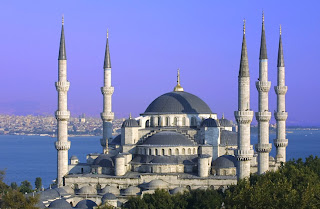
Although it is a very touristy area, I am glad to have settled here, because since it is here that I first came when I came to İstanbul, I am now quite familiar with the area and I am getting to know all the working people by name. The people know me too, the ''English Teacher,'' and no longer bother me or try to tell me things. Everyday, whether it is to go to work or shopping or to meet someone, my walk takes me in between the towering Sultanahmet (Blue) Mosque and the Ayasofia. It is quite a nice walk, and sometimes when you stop and think how many people for how many centuries before lived, worked, and died in that small area, it boggles your mind a bit, and you think of what a long way, or not, people have come since the times of old.

Snowy Blue Mosque

Ayasofia


When I have time, I visit my friend Aladdin, who, yes, is a carpet seller. In his spare time, however, he keeps pigeons, and every morning I can usually find him in a back alley caring for his pigeons. It is a popular hobby here, and many people do it. Since the weather was nice today, he let them out to fly around a bit for excercise. He would throw snowballs at them to get them to fly around a bit, and seeing us throwing snowballs around like two fools, an imam came out and began a snowball fight with us. Later, our hands frozen from rolling snow, he invited us for tea and, of course, tried subtly to convert us to Islam. Yavaş. That's how it goes here.


Feeding time

Surprisingly, food here can be kind of expensive - big city, what did you expect? However, every Wednesday there is a bazaar a few blocks from where I live where I do most of my shopping. Things are usually cheaper if you buy at the bazaar, or go to different shops (bakery, bazaar, Bim for cheese and ayran, etc.), but this requires a lot of walking. Not that I mind, though. I kind of like working a little....it makes you appreciate the convenience and seemingly endless bounty of the supermarkets back home.
I have a long ride to work everyday. I have to ride the tram half an hour to the end of the line, and then transfer to the aırport train, which I ride for another 15 minutes, so it usually takes about 45 min to 1 hour to get to work. I don't mind though - it gives me some time to think or read, or brush up on some Turkish.
The surprising thing about slowing down is seeing how much time there is in each day. The days are so long. Duh, you might say, but its diffeent than that, there is a certain beauty to it. Exactly what that is, I can't say. Perhaps that what yavaş really is.