Tuesday, July 6, 2010

Şile'ye

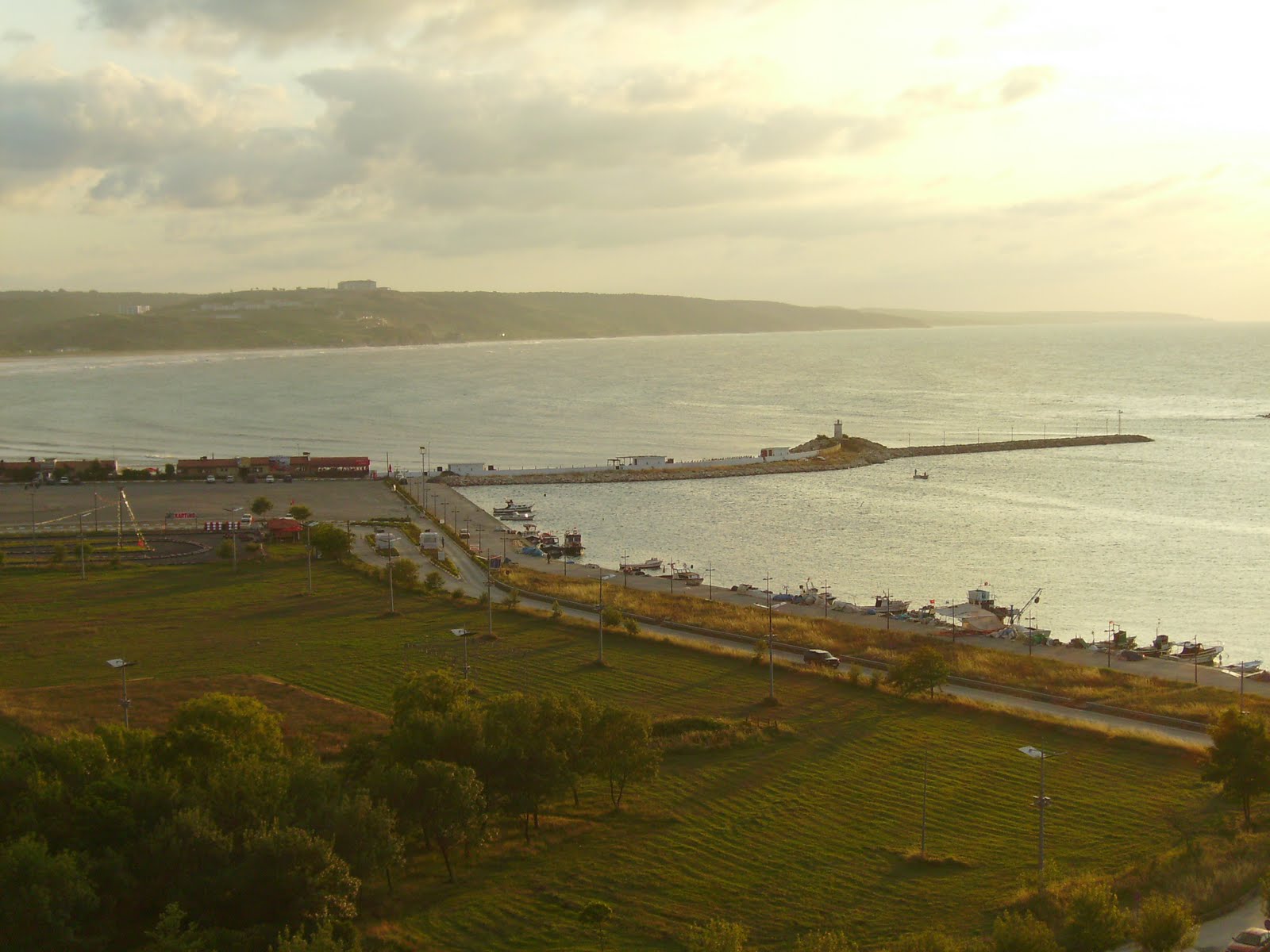
I finally left İstanbul for the first time in 5 months three weeks ago, to a small town on the Black Sea about two hours outside of İstanbul called Şile. Since it wasn't a weekend, it was quiet and lovely and the bright sun and brilliantly turquoise sea made it a lovely day out. As you can see from the photos, "Black Sea" is a misnomer.


I finally also went swimming for the first time since probably last October - my how wonderful that was, to get wet and sand between my deathly white toes. The sea was neither hot nor cold, and it was clear despite some roots and seaweed floating around in it. Unfortunately because the Black Sea is infamously rough, I couldn't swim out too far, despite it being relatively calm (in my Atlantic opinion).


Good thing I had my Carnival nuts


After a delightful dip in the sea, I was able to satisfy another yearning - rowing. It was so nice to have the sun dry the sea salt in my hair again and row lazily down a river.


Nothing like finishing off a seaside day with calamari, stuffed mussels and rakı in a seaside restaurant.


I was very angry to be back in İstanbul the following day.

Sunday, June 20, 2010

The Bazaar of Useful Shit (Episode 2)

As I said earlier, the nice thing about this place is that you hardly ever need to walk into a store.

Sure, for things like milk, juice, cheese, toilet paper, household objects - the necessities - you need to go to a store, but otherwise the need really isn't there because of street peddlers and weekly bazaars. Sometimes, there are peddlers that come by who sell cleaning and the aforementioned necessary household objects, but of course, I can never find them when I really need them.


Can't miss this guy, but he remains elusive


If you need fruit, there are meyveci, fruit sellers, on nearly every corner. Sometimes they have a cart they push around, but a lot of the time, especially now during the watermelon season, many men just park their car or truck on the corner and sell melons out of the back.


If you need a quick snack, there are all kinds of peddlers about selling a variety of healthy snacks to sate your appetite: roasted corn-sellers, rice-sellers, roasted chestnut-sellers, simit-sellers (simitçi), stuffed mussel-sellers (dolmacı), pancake-sellers, sandwich-sellers, meatball-sellers (köfteci), and so on. That's another thing I like about this place - all of the "fast food" or quick snacks are fresh and healthy. Of course, you need to beware of low quality döner meat and always wash your fruit before consumption, but otherwise it beats going to Burger King and the likes.

But, as I was saying, the bazaars here are awesome - they make you never want to go into a store because of the fantastic vareity of items that can be found there and, of course, the low prices and the possibility to bargain. Where I live in Fındıkzade, there is a major bazaar every Friday. This bazaar is famous throughout the city because of its sheer size and availability to buy anything that you need.


Thuırsday Morning


Same place, Friday morning

By my estimate, the bazaar spans about eight square blocks of my neighborhood. The streets are closed and cleared of vehicles, and the vendors arrive early (for Turkey) in the morning to set up their booths and merchandise. By 9 am the place is a madhouse: vendors shouting "Buyrunbuyrunbuyrunbuyrun! Bir lira bilirabilirabilirabilirabilirabuyrun!" (Yes please one lira!!!) at the top of their lungs, people thronging the tables rooting through piles of clothes and fruit and other goods; the bargaining is fast and cash changes hands rapidly. The bazaar can be a a pain whenever I have to go out and make my way to the bus stop, because it is so crowded and it takes a long time to pass through.

But it really does have everything you need, from fruit to fish to cheese to olives to toiletries to silverware to plates to hair scrunchies to shoes to pots and pans to clothes to fake Converses to simit to tea to nail files to mirrors to flowers to plants to swimsuits to baby clothes to vegetables to nuts to spices to.....well, you get the idea. You can get an entire week's shopping done by only walking two blocks. There are even men who walk around with great big baskets on their backs who will carry your goods home for you. Everyone makes some money at the bazaar somehow.


The best thing about the bazaar are the smells and trash that get left behind. On days where I work all day, the bazaar is just getting started, but by the time I come home the streets are once again empty and the streetsweepers have begun the monumental task of cleaning up the day's garbage. As I walk home, it is easy to imagine the lively environment that was there earlier that day - here was the sock-seller, and there where the wilted lettuce is was a fruit seller. There is a broken tea glass, and a half eaten simit. Olive pits everywhere, and plastic wrappers. And clearly, the fish seller was on that corner with the street cats enjoying the foul scent of the long gone fish tables. What interests me most about the bazaar is not the bazaar itself but the aftermath of it - the discarded candy and broken plastic and soda cans. Most of all I wonder what is like to be a street sweeper - what kind of treasures have they accumulated after cleaning up the endless parade of Friday bazaars?

Thursday, June 17, 2010

Thursday Morning

Its Thursday morning after a long stretch of split shift work days. I finally got to spend some much needed time at home to do some laundry and housecleaning. You know, to get rid of the fresh batch of dead flies that have collected on the floor. Not much for breakfast, but what food is in the fridge is good and wholesome; last week, Kürşad's family sent him some fresh food from his farm in the village in Kayseri: fresh sheep's cheese, 3 kilos of cherries (we made short work of them), fresh sausage, kaymak (a kind of cream made from yogurt), a jar of unbelievably spicy peppers his father cured, pastırma (a kind of spiced cured meat that is unique to that region), and, of course, some kind of animal organ. Not sure what he plans on doing with that, though. Village people......


Yes, that is some kind of animal heart next to the yogurt


Wa'allah that's a big simit!!

Off to do some errands now that I have the time!!

Thursday, June 10, 2010

English Time Şirinevler

Şirinevler is a crowded suburb of the greater city of İstanbul. Because Şirinevler is a ways outside of the city and is inexpensive, most of the people who come to İstanbul from the viallages of Anatolia to seek work or a life settle in Şirinevler. This means that Şirinevler is crowded and often dirty, because of its location next to one of the city's busiest highways and its role as a minor transportation hub. But it's not a complete hole. It's more of a working class neighborhood, incomparison with the planned, upscale neighborhood of Ataköy, which faces Şirinevler from across the highway. It is also near the airport, so there is always activity and people coming and going. For these reasons, Şirinevler is a bit of a misnomer - in Turkish it means "cute houses". I always got a ride out of that.


Looking west, towards the airport


İstanbul as far as the eye can see


Şirinevler square and the main mosque


English Time, the business - ahem, school, where I work has nearly ten branches all over the city, but I work at the Şirinevler branch. I wouldn't have it any other way, because even though it is crowded it is out of the way, it is inexpensive, unpretentious, and bit seedy and, therefore, genuine. Most of the students don't like the Şirinevler English Time, but it is fine by me.


It is located at the top of a high rise work center, only one long hallway of classrooms and two offices. I like this because you don't have to know your way around. Once, or twice, I had to cover at a different branch and I hated it because there were 6 floors that all looked the same so I could never find my classroom. The Şirinevler branch is simple - there are about 10-13 classrooms along the hallway, that's it. There is also a little canteen where you can buy cookies and crackers and drinks, but it is a little pricy. Sometimes it is nice to sit in there between shifts when no one is around.


One of the unique things about the education system in Turkey is the requirement of all classrooms to have a short inventory list on the wall cataloguing all the items in the room, as well as a photo of Atatürk, his "Youth Address", and the "İstiklal Marsi", something like a national anthem. This is mandated by law, and the Atatürk photo must always be set a bit higher than the "İstiklal Marsi" and the Youth Address. There must also be one in the main hallway for everyone to view.


I have a varied work schedule. During the weekdays, there are two classes a day: the morning class, which runs from 10 am - 2 pm, and the evening class, which runs from 7 - 10 pm, with a 10 minute break every hour. On the weekend, the morning class runs from 9am - 1 pm and afternoon from 3 - 7pm. English Time breaks the levels of proficiency down into 6 levels, so a weekday class, a level, takes about one month to finish, but a weekend class takes about 4 months to finish. This means that my work schedule changes about every month or so, depending on whether new classes open up. I always work on the weekend. Now, in the summer, students are hot and take holidays, so business is slow, but luckily I have work, so I am thankful for that.

The best thing about working at English Time Şirinevler are the teachers. The students are great, but the rapport and lively comraderie between the teachers makes the work tolerable, even enjoyable at times. All of the teachers get alont great, which is a bit unusual; once, when I had to work at the aforementioned different branch, I found the teachers there to be chilly and unconcerned. Not so at Şirinevler - we all get along, joke with one another, help each other, and spend time together outside of work. All of the teachers here are hardworking and care about the students' progress and do our best to make sure they understand things, and to make learning fun and interesting as well. We have one Turkish teacher who helps the students with their grammar problems, Feyza - she is very affable and charming and helps us out a lot, making the teachers' room a great environment and everything a bit easier for everyone.

Martyn, our token Brit hard at work

My Turkish friends, Feyza and Ali

Everyone at the Şirinevler English Time makes it a nice place to work - Şirinevler may be gritty, but at least the staff and students help our branch live up to being a "cute house"!

Tuesday, June 8, 2010

The Bazaar of Useless Shit (Episode 1)

One of the things that is great about this place is that you hardly ever need to walk into a store.


Whatever you need at any given moment is probably being sold by someone on the street not far from where you are at any particular time or place. Of course, this also applies to what you don't need as well. Whether you are casually standing on the street or purposefully going someplace, there will always be a peddlar nearby to offer you the silliest and most useless things. This is standard across the city.


Most common are the old women selling tissues and candy out of shoeboxes. I don't know if these women are just bored or miserably poor, but they will spend the whole day wandering with their box of tissues and candy, entreating every passerby to buy. I have to hand it to them though, they do try - it's better than the fat, lazy ones who spread a newspaper on the stairs in everyone's way, sit down and beg, palms open, Allah rahsosun!, God bless you. Yes, because starvation and poverty makes you fat as a whale.


Also standard in every district of the city are one or two zenci, black Somalians, who walk around with a red velveted board on which a fine selection of fake watches is displayed. They sidle up to you slyly and show their goods with a slight nod, as if divulging a secret. I can't vouch for the quality or bargain prices of these watches, but I find the practice enigmatic - I've never actually seen anyone buy from these men, nor have I ever heard them speak. They roam the streets silently, like shadows, disappearing as quickly as they appear. Turkey is a relatively homogenous country, so an African makes you look twice. The consensus among the Turks is that these Africans come here from some lawless, war-torn African country hopeful to pass into Europe or England clandestinely. Istanbul is just a waypoint for them, another caravansaray along the way.


I don't know if this woman bought or not

Many times older, disabled, or unemployed people will sit on the sidewalk, put a blanket on the ground, and lay out a variety of objects to sell with the care and precision of a museum display. Of course, these objects are useless (unless you smoke or have a hangnail): cans of lighter fluid, some matches, lighters, tissues, tesbiis (religious prayer beads), nail clippers, combs, and so forth. Usually there is a bathroom scale there as well, and for 50 kuruş the old man will let you step on the scale and tell you your weight. Sometimes if someone has been up on his luck he will have other things to sell, like television antennas, old radios, remote controls, keyrings, and used batteries. Yes, if they find it and it appears that it will work, then they can sell it.


Some men aren't content to sit in the same spot all day and therefore take these objects on the road. Last week, while Üskan and I were standing on the street killing time, a man walked up to us and revealed some multi-purpose screwdrivers and manicure sets. Üskan, casually leaning on the fence with his thumbs hooked cooly through his belt loops, inspected these objects with a knowing carefulness. After a moment, he nodded slightly, raising his eyebrows and puckering his lips as he *tsk*ed no - sorry, no thanks, don't want that garbage - and the man moved on. This happens a lot; men come along with briefcases of sunglasses, bags of socks, or duffel bags stuffed to the brim with "brand name" jeans or polo shirts. It's nice to know that if I suddenly decide that I need a pair of jeans or a screwdriver at any random moment, someone will surely be along to help me.


But usually most of the time it is in the afternoon or at night that these "bazaars" spring up on the sidewalks of İstanbul. Usually old men, widows, or the unemployed will set up shop right on the sidewalk to sell anything and everything no one needs. Things get particularly lively at night, and especially in the seedy areas of the city, like Aksaray or Şirinevler, where I work. In Şirinevler, there is a pedestrian bridge over the highway that, after 9 pm, really does become a bazaar - there are old phones, antennas, cell phone covers, bootleg DVDs, scary plastic dolls, socks, belts, underwear, an unimaginable collection of the most irritating battery-powered toys, books, kitchen utensils, shaving accessories, pens, bootleg Georgian and Bulgarian cigarettes, lighters, gaudy jewelery - you name it. It really is a bazaar of useless shit. I have come to think that these salesmen come here under the cover of night to sell because the darkness masks the poor quality of their products; once, I bought four pairs of socks for 1 lira, and after wearing a pair once my foot was stained black and the sock was thinner than tissue paper. Useless.

Where does all this useless shit come from? Well, not China, as you might be surprised to hear - it comes from Turkey; almost everything you see here is made here in Turkey. The brand new stuff, I mean. But the things that are used and no longer wanted are collected, repaired, and sold again. This may sound strange, but it is actually the most efficient recycling system I have ever seen. Many people in İstanbul actually make a living collecting old things. These people are called eskici.

The eskici is most undoubtedly one of my favorite things about this country because I think it is so funny. The eskici has a cart he pushes around all day while yelling, "Eskiciiiiiiiiiii!!!!!" If the eskici comes and you have things you need to get rid of, you call him, give him your unwanted items, and he gives you a little bit of money for it, if you want. What's so funny about that? you say. Well, the "call" of the eskici is particularly funny - some men have a deep, throaty call that sounds like a croaking frog, animal like. Other men say "eskici" in a way that sounds like "sıkıcı", which is the Turkish word for "boring" (pushing around a cart all day? Yes.). Most of the time, it just sounds like a low, incomprehensible moan. This is enhanced by the fact that in my neighborhood at any given time during the day there are at least 3 eskici working in a 5 block area. So all day, you rhythmically hear eeeeeeeeeeeeeaaaaaaaaaaaaa! Ooooooooooooooooooooo! After a while, this gives the feeling of living in a jungle of some sorts, the constant sound of animal calls in the background. Or, at least, like the streets are filled with raving derelicts.


Eskiciiiiiiiiiiiiiiiiiiiiieeeeeeeeeaaaaaaa!!!!!

There are also many men who walk around with a giant plastic sack on a hand truck all day, moving from dumpster to dumpster to root around and pick out the plastic and paper materials that they can sell to recycling centers. I scoffed at this at first, but a woman I work with told me that it wasn't a rediculous job - a man she knew had bought an entire house for his family solely by picking paper out of the garbage. So perhaps useless things are only useless in the eye of the beholder - one man's trash really can be another man's treasure.

Thursday, May 27, 2010

Ağa Bey

I like how pleasant people are to each other here. When I say this, I mean the formalities that they assume when conversing or addressing one another.

Of course, as a teacher, my students will call me "teacher" quite often and not by my name. At first, this was irritating because I thought that the students didn't remember my name, so they just called me "teacher" instead. Later, however, I was informed by another teacher that this was actually a sign of respect; if a student calls you by your name, it means they see you as an equal, which is actually a little rude since respect for the teacher is common in this culture. Perhaps it is a bit haughty of me, but I get a little irritated now when a student calls me by my name, because I know this and I am used to being called "teacher".

Sometimes, although less common, a student who is particularly polite or respectful will call you "hoca" (hodja). This is an old word that was commonly used as a respectful term for a religious teacher, but nowadays people use it as a term of respect for any type of teacher. Personally, I like being called "hoca"; it makes me feel more important or older than I really am.

There is an entirely different set of words for people older or who should be respected. For example, for older women you know that you work with or live near, you have to call them abla (abla espanol?), which means "older sister". If there is an older man who helps you or who you respect, you can call him amca ( am-jah, paternal uncle) or dayır (maternal uncle). If you don't know someone well and want to be particularly formal you can call them Efendim, Sir or Madam, but this word has different meanings depending on the context:

a) If you want to call someone Sir or Madam, you say Efendim.
b) If you answer the phone, you must say, "Efendim?"
c) If someone calls your name, you can say, "Efendim?", like "Yes?"
d) And, of course, if you didn't hear what someone said, you can say "Efendim?" - Pardon?

The most common, and friendly, forms of address between men (different world for women, I don't know) however are ağa bey and kardeş. Ağa bey (aaah bay) means "older brother", and is a common form of address between people you are both friendly and unfriendly with and is used very often: "What's that ağa bey?"; "Sorry, ağa bey."; "Where are you, ağa bey?" and so forth. It's almost mandatory at the end of the sentence sometimes. Usually people who are older than you, the same age as you, or younger than you but you respect are ağa bey. Kardeş (younger brother) serves the same function, but is used only for people who are younger than you.

An then, of course, the chummier varieties of address abound: dostum (buddy), arkadaşım (my friend), kanka (pal), and lan (dude) are all common between friends.

Of course since these terms of respect and friendship abound, so do the greetings and personal inquiries. One of the things I like about Turkish people is that, like Americans, they ask you how you are doing. This is in contrast to Europeans, who don't care how you are and see the question as a superficiality. But of course when you meet someone, in Turkish, there is a slue of greetings all at once: "Merhaba! Nasılsın? İyiyim? Ne haber? Ne yapıyorsun?" (Hello! How are you? Good? What's news? What are you doing?) and so on.

Naturally this can be quite much after a while, but it is endearing nonetheless. The funniest thing about this, in my opinion, is that "Thank you" is an acceptable response to all these greetings. So naturally, one of the hardest parts about teaching Turkish students is teaching them not to say simply "thank you" when someone asks, "How are you?"

Thursday, May 13, 2010

An Interlude

The weather was wretchedly hot and the sun unnecessarily oppressive. Even though my apartment was cool and shady, I was bored and itched to get out. The monotone buzzing of a solitary black fly that had gotten trapped in my abode exascerbated this feeling - the hopeless boredom of a hoplessly hot day. I grabbed my camera because, as you know dear readers, I have pathetically little photographic evidence to show for the amount of time I have been here, and stepped out into my sunny alley.


I walked down to the pedestrian bridge that overpasses the tram station and the highway to see if I could get a decent photo; on some clear days, you can see the Asian side from the bridge, but since it was hot and hazy, and the trees had acquired significantly more foliage since the last time I admired the view, Asia was now nothing more than a blurry hump in the distance.

Anatolia, in the distance


Fındıkzade

The sun was hot and bright, and I thought it to be a good day to have a walk down by the water.


Cerrapaşa

Now the interesting thing is that my apartment in quite close to the Marmara, but it takes a bit of effort to get there. You have to cross a busy street, then walk down a steep hill, cross another busy street, walk through an underpass under the railway, and finally cross a dusty, dangerous highway before you are near the water. The walk is worth it however, because there is a lovely seaside park which begins at the ruins of the old city walls and stretches east along the shore towards the Bosphorous. On Sundays, there are countless picnicking families, tea-sellers, and simitçi enjoying the green park and the sunshine.


On a similar trip about a month ago to this park with Christine, I saw people on top of these old city walls, playing on them, drinking beer, loafing. I wanted to have a little adventure and explore the wall ruins, which are remarkably intact, and unrestricted to the public.


The ruins of Constantinople

What once protected Constantinople is now a stomping ground for gypsys, hobos, naughty teenage boys, and any other soceital tripe that washes up from the Marmara or down the hill from Cerrahpaşa. One is met with wholly unsavory odors and sights when venturing into the ruins of the old city walls. The walls inside the arches are charred black from countless drunken hobo fires, and the ground is littered with all types of filth and trash - broken bottles, beer cans, plastic wrappers, old rotting clothes, seed shells, and crumpled cigarette packages. The stench was unbearable; the whole place reeked of dead animals and the foul, steamy odor of its continual use as an open toilet - the stench of countless people shitting and pissing there for who knows how many years. A walkthrough made one retch.


Gypsy paradise

Yet despite all of the filth and trash, there was a certain beauty about these ruins from a faded past. Outside, they evoked the romantic nostalgia of another age, and pretty little yellow and white and purple flowers sprang from the cracks and seams in the stones. A gnarly tree's red berries beautifully contrasted its deep green leaves and the faded siena of the old wall.


A shortcut to the sea

Curious to get to the top of this heap of ruins, I found an ancient severed stairway that led up to the ramparts. I managed to scale the wall a bit up to the bottom stair and pulled myself up the crumbling wall and onto the marble stairs. I walked up to the top and was met by a stiff, cool sea breeze - it caressed my moist skin and cooled my sweat-beaded brow, and I breathed the refreshing air into my lungs. The Marmara lay wide open before me, made impossibly vast and small at the same time by the hulking mountains in the distance. Moored ships drifted lazily with the tide. I sat down on the crumbly, dusty stones of the wall and absorbed the sun and the sea. On the sea wall slightly offshore, a couple wandered aimlessly about, hand in hand. On the jetty behind the sea wall, an old man had moored his boat and was stretched out shirtless on the rocks while children played around him. Nature and life, sparkling and shining. Even the beer cans and cigarette packages up here couldn't ruin the view.


A good way to spend the day


As I returned to the stairs to descend, I saw a police officer across the highway pacing aimlessly and flushed momentarily; however, I quickly remembered that I wasn't in America anymore. The police here aren't nosy and killers of fun like they are back home - no "Hey, get down off that cultural monument!" here. They could care less. This fact was indeed confirmed as I climbed off the bottom of the stairs and jumped to the ground; as soon as I had come off the wall, I heard a broad, flat crunch and looked up to the highway to see that two cars had smacked hard into each other. As the two drivers got out and argued angrily, the traffic policemen sauntered over ambivalently, unhurriedly. I feel you man - too hot to hurry.


I decided to head back up the hill at this point to seek some shade. I was sticky and soaked by the time I got back up the hill, and decided to seek the cool shade and fountains of cold water from the neighborhood mosque courtyard.


The Ali Paşa Hekimoğlu mosque

Of all the mosques I have seen here, this mosque, the Ali Paşa Hekimoğlu mosque, is by far my favorite and in my opinion the most beautiful. The courtyard, shaded by tall broad pine trees,
is wide and extremely well kept, with pretty colorful flowers bordering the impossibly green grass. It also houses some small cemetaries as well as the tomb of Ali Paşa Hekimoğlu (whom I admittedly know nothing about, but the marble plaque on the wall of his tomb says he was an awesome man). There is also a large marble cistern filled with clean, clear water for ablutions, and a vined trellis under which tired old men pass their days. The most incredible thing about this courtyard is that it is so quiet and peaceful despite it being olny a few yards away from a busy street and intersection.


Glorious shade


A good way to cool off

Now when I first moved to Fındıkzade I - unsurprisingly, since there are over 3,000 in this city - didn't think much of this mosque, that it was just another of many. However, while looking in a book at the book bazaar a few weeks earlier, I saw a picture of this particular mosque and was taken aback by its beauty. Luckily it was open, so I took off my shoes and stepped inside. The book - and Chrissy - were right. The high white ceilings of the domes were beautifully embellished by hand-painted flowery Quranic excerpts. Hairline cracks in the plaster testified to the mosque's age. The windows were decorated in the most beautiful fashion with blue, red, and green stained glass, and brilliantly transformed the sunlight shining through. Unfortunately, I only had a few moments to absorb the architectural beauty inside, and a man was locking the mosque up until the next prayer time. As I put my shoes on and meandered in the courtyard, I admired the intricacy of the carved marble. Funny, I thought, that when someone put these stones here, our homes were still wilderness. Along the side of the mosques, some students were also studying the architecture, but in a more profane way. As I walked through the courtyard arches to leave, I noticed the stone turbans and epitaphs of broken headstones lined along the low wall of the cemetary. Staring at the Ottoman script on the stones, I wondered who these people were, or even if this final legacy of theirs could even be understood, as Ottoman Turkish is no longer spoken and is on its way to being a dead language.


Hot weather, cool marble
I'm sure that was no easy task


Gone and forgotten?
Hot and sweaty, I turned to go home and quench my thirst. And get ready for work.

Tuesday, April 27, 2010

Culture, anyone?

What do you think of when you think of Turkey, my friends? Perhaps you think of faded aged, rugs, kebabs, the sweet licorice-like scent of nargile smoke, the sharp minarets of mosques abruptly interrupting the skyline and their azans tiredly punctuating daily life. Perhaps you think of the paradox of bearded, turbaned men and headscarved women contrasted by the seductive oriental fables of sultans' gluttony and harem fantasies. Perhaps, like myself before I came here, you don't really know what to think about Turkey at all, on second thought.

It's one of the most profound, and deeply irritating, questions of the postmodern era, namely because no one can come to an agreement on it: what is culture, and what is identity? Thousands have passed their lives buggered by the question, and once you think you've got it, someone comes along and says, ''No, no! Wrong! It's more like.....'' It is further complicated by the multiplicity of cultures in the modern world and, even further by subcultures and identities......my what a mess liberal thought has made of soceities. The silliest thing about it all is that people actually have time to concern themselves with matters such as these. Imagine if people put the same amount of time and thought into things such as ''How can we get water to that village over there?'' or ''Well, how can we get those swindlers on Wall Street to stop buggering up everyone's lives?'' But now I'm rambling, excuse me.

Regardless, it is natural for a product of the Western education system to ponder matters such as these, no matter how ultimately unimportant they may be. Of course,as an American doint a stint in İstanbul, I have of course been asking the culture question - of Turks and myself:

What is Turkish culture? What is culture?

Good question, and naturally everyone has something to say about it. I try to be as open minded as I can, especially when I travel. Not an easy task, but I think I can score some points for trying. When I came here, I honestly admit I didn't know that much about Turkey. It's easy enough to imagine American culture - gunslinging cowboys, Coke, Hollywood and such - but what about Turkey? Well, I know they are muslim there. They eat a lot of grilled meat, and I hear they like to drink tea. It's probably hot, a lot of sun. And I'm pretty damn sure they don't speak Arabic there. So when I got here, I was pleasantly surprised by many things - the people are friendly, and the food is good. Everyone is clean, not too conservatively religious, and the language is pretty simple. Anti-American sentiment isn't too strong, and surprisingly, a lot of the time I feel like I'm living in the middle of Europe, sans stuffiness of course. But wait a second - isn't this a muslim country? Indeed it is, and the paradoxes are quotidian; stare at the big-breasted sunglasses advertisement while waiting for the ancient bus and hear the azan drill your eardrums out. Watch the headscarved girls wearing Converse high tops and Gucci bags walk by.
Arabesque music from one car blasting by, Rhianna from the next. So which is it, you ask yourself, what's the culture here?

I'm sure I'm not the first idiot to ask that question, and I sure as hell won't be the last. To be honest, I really don't think I'm in any kind of position to make an educated guess about it seeing as how I have only been here for a few months, anyway. So I ask my freinds and students: does Turkey have its own culture?

Surprisingly, most of them say no, no it doesn't. Why not? Well, think about the history here chummy: first, there were the shamanistic Turkic tribes. The the Greeks came with their polytheism, followed not too long after by the Romans. Soon they evolved into the Christian Byzantines, who were ousted by the Ottoman Turks, the warriors of Islam. They had a good run at it, but eventually even they were done away with by Atatürk, who founded the modern Turkish republic based on the western model because of a personal distaste for all things Ottoman - the old Arabic abjad was replaced by the Latin alphabet, suits replaced traditional garb, and in general everything European was forced into fashion. So you see, how can we have our own culture since the cultures of others have been battling for supremacy here for the past 2500 years? A valid point indeed, especially when you think about it; can't the images of dim brass lanterns and carpets and harems be traced back to the near east, and those of flashy sneakers and cell phones be traced to the West? The sole unique thing about it just may be the language - it's completely unrelated to any European or Semitic language which surrounds it (despite having acquired a great deal of loan words from Arabic). Perhaps it is not so much that they don't have their own culture as they haven't had the chance to create one.

Well, be that as it may, most Turkish people are proud of their culture and identity, and they should be. Even if it is a product of historical mish-mash, it is rich and colorful. Recently, I had a discussion about this with a more advanced student. Turkey may not have its own culture, but it has strong traditions, and isn't that a good part of culture? American culture is weak in comparison, he claimed. I certainly begged to differ on that point, but regardless in the end, I was left pondering: which is worse? To have a weak culture, or to have yours borrowed from another?

I'm sorry. I suppose by now I could have gotten water to that lone village.

Sunday, April 18, 2010

The Busy Rhythym

Again dear followers of this blog, I am sorry for not keeping it up as I should. I know many of you check here often to no avail. But I have good reason! I hadn't had the time because I had been so busy, what with my time slpit between work and spending time with Christine since she was here. She stayed here for the better part of a month and we had a wonderful time, cooking, exploring, loafing, smoking nargile, enjoying the city.


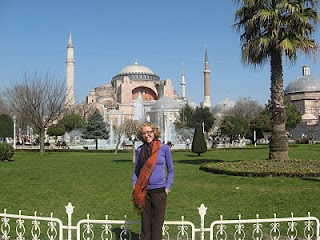
I explored a lot of İstanbul with her that I hadn't seen for the time that I had been here. I played tour guide for a little while while I lived in Sultanahmet: the Blue Mosque, Eminönü, the Grand Bazaar, the Spice Bazaar, the nargileci tucked behind mosques that felt like stepping back into the Ottoman days of the 1600s when you went inside. She explored a lot of the museums and such herself though while I was working in order to keep busy, so I am apparantly still missing out on a lot of good stuff. We did make it to the Archaeological Museum together, but I wish it had been another museum we had gone to; let's just say this prospective visitors - don't come here just to see the archaeology museum. At times it was like the Greek section of the Met.


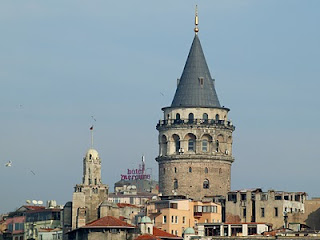
One day, when the weather was halfway decent, we went up in the Galata Tower, which is across the Golden Horn from where I live. It is a stone tower built in the 7th century by the Byzantines that functioned as a lighthouse, a fire tower, and a prison at various times, but nowadays it houses a restaurant/nightclub and a narrow balcony where tourists can go out and view the cityscape and the Bosphorous. Since it is on a hill it does indeed provide an excellent view of the city and you are actually higher up than you think you really are. Legend has it that around the 14th century, one man fashioned some wings made from fabric, jumped off the tower, and glided to the other side of the Bosphorous while the sultan and thousands of people looked on. At first, the sultan was pleased, but on second thought he had the man put to death because he feared he may have been some sort of magician or sorcerer.


The view from the top really is breathtaking; on the day we went up you could see clear for fifteen or twenty miles, and apart from the sea and the mountains across it, all there was to see to the horizon was city. İstanbul. You don't really know how big the city truly is until you go up in the tower and see it stretching to the horizon. New York built up, but İstanbul built out. Indeed, you could say that İstanbul is no more than a collection of villages. Many parts of the city actually still retain their village names: Bakırköy (Copper Village), Karaköy (Black Village), Arnavutköy (Albanian Village), Yeşilköy (Green Village), and so on. You really get a sense that İstanbul really is too big for one continent when you are up on the balcony of the tower, looking over the terra cotta roofs with the salty wind blowing in your face and the sound of ships' horns belching in the distance.


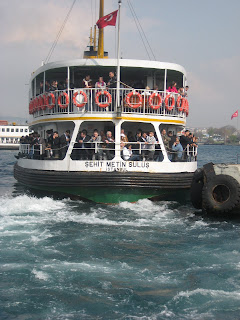
Another day we took the ferry to Kadıköy, on the Asian side. The ferry boat is the same fare as riding the bus or the metro, so it is an inexpensive activity for the student or budget traveler. Like the Staten Island ferry, everyone waits in the terminal until the arriving passengers get off the boat, and then once the doors open everyone throngs toward the entrance and you get squeezed like a tube of toothpaste. On the boat we clambered across the rickety wooden gangplank and climbed over the massive piles of ropes and got a seat along the rear starboard gunwale toward the stern. On the way over a thick salty haze over the water made it difficult to see to far, but the deep, cold water was a brilliant blue green color, and sparkled in the weak sunshine.

The Asian side of İstanbul was pointedly less crowded, more laid back and relaxed. People didn't have the urgent hustle of the European side, and the energy was much more easygoing and welcoming. Since we went in the late afternoon, we didn't stay long, just long enough to get a feel for ''The Other Side'' and to catch a few cups of tea, a nargile, and a balık ekmek (fresh mackerel sandwich). On the way back, the setting sun bathed the city in an orange glow, and as the temperature dropped rapidly as we crossed the Bosphorous our puffs of breath mixed with the salty haze over the water. The other side was nice, but I was glad to be back in Europe - back in the busy rhythym. As the boat moved in place to dock, people began climbing over the rails and leaping onto the dock before the boat was even close to being tied up. I laughed and enjoyed the romance of it - it was quite the contrast to back home, where insurance and safety regulations take the fun out of everything. People do still live in some places.


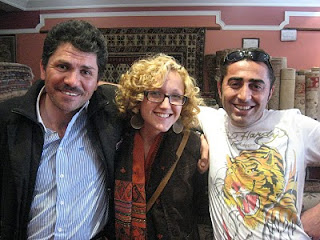
Aside from exploring and running around, going to the gym and hanging out in parks and exploring mosques and cooking and olive-tasting at bazaars, Chrissy made some friends as well. Well, more like she stole my friends from me (wink). Her abundant free time allowed her to spend more time with my friends than I could, and she was well liked by all of them, probably more than I. They gave her countless cups of tea and great conversations and stories, and they were all sad when she left. My friends Kürşad and Üskan had a particularly fun time with her, jocularly joking her with and trying to get her to go home with a carpet, a small Afghan horse-hair carpet that I actually really liked and kind of wish she bought (wink again).


A man's woman


The 15 lira dinner

We did so much and had the best time together, and it was too soon for her to leave; there was still so much to be done. It felt like she had been here with me all along, and now after she has gone my new house, which she moved into with me, is emptier and lonlier, because she made it homey with me. In many ways, it isn't, and won't be, the same.
Nontheless, changes at work coincided with her leaving. One teacher, who went on vacation, decided not to come back, and with another teacher being fired, things have been hectic around the school trying to get the teacherless classes covered. So now I am very busy covering classes, and I don't have much time for anything else - forty hour weeks with Wednesdays off for the time being. It's good because it is keeping me busy, and the exhaustion will be worth it in the end.
But the busy rhythym has been lightened by one thing: I bought a new typewriter for my collection. I haggled with the old keymaker and got it down to 65 lira ($50), and what conditioın it is in. A Turkish Typewriter!!
Mom, make some more room in the attic!!

Quite the keyboard indeed