
Saturday, June 30, 2012
Friday, June 1, 2012
Trieste
We got the itch a few weeks ago, and while a quick search of Skyscanner found flights to Lamezia Terme, where our friend Roberto lives, to be too expensive, an 'aha' moment of mine revealed a bargain on flights to Trieste. So Saturday morning we packed a weekend bag, grabbed a book, and headed off to Stansted.
Now Trieste is no common tourist destination. In fact, the main reason we headed off there is because of Anna's strong connection to the place--she spent seven years there for university and as a result all of her friends are there, and it has become something of a second home for her, albeit one she never gets to visit. So after a two-hour continental flyover and a birdseye view of Venice, she was quite happy indeed to be back in Friuli Venezia Giulia, where her friend Cili was waiting for us at the airport.
The weather was gorgeous; clear and sunny and cool, nothing like the sweaty mess we left behind in London. On the way back from the airport, I rolled the window down and drank the cool, pine-scented sea air. Rolling into town along the coastal road, I immediately saw why Anna loved Trieste so much--it was a gem of a city, and a hidden one at that.

After arriving in town, parking the car, and dumping the bag, we set out to take care of priority number one, the first thing we always do when going to Italy: sandwiches. If nothing else, the Italians do not fuck around when it comes to sandwiches (or any food, for that matter). So we found a little café around the corner, and I occupied myself with a mouthwatering prosciutto cotto sandwich and a shotglass of beer (here the Italians lose to the Brits) while Anna caught up with her growing entourage of friends. Incidentally, the day we arrived was not only her friend Mino's birthday, but also the annual "Cherry Festival". Trieste has a large Slovenian population in the surrounding mountain villages, and every year in May there is a festival celebrating the first cherry harvest. In the past the group of friends had gone every year, so naturally, we were going that evening.
So, a few hours later, we headed up into the hills to the Praznik Češenj ("cherry festival" in Slovenian, forgot what it is in Italian), which was in a quiet little village called Mačkolje. How cute, I thought. "I'm so hungry," Anna said as we walked up after parking the car. "They have these little sausages, civa, they're delicious." Good, I thought; that sandwich was only to hold me over for the main event, the Praznik, and I was starving.
The praznik, however, was a mob scene. Really, there must have been about 800 people queued up around the blazing, smoking grills. Oh boy. Rumor had it it was an hour's wait. Damn. Someone smart in the group had the brilliant idea that two of us would get in line to get the tickets, two would get in line for the meat, and two would get in line for the chips/cherries, and after the tickets were bought they would be passed off to those waiting in line, who would be near the front by the time the tickets were had. It was a good idea, but it still ended up being an hour's wait. And of course, Anna and I were in the meat line, which took the longest. I admit I was getting irritated being stuck in the crowd and tired of waiting, but as we got near the grill I felt more bad for the poor Slovenian folk working the grill, hot and sweaty and sooty smoke blasting into their faces.
In the end, we ended up waiting a while, but the food was delicious, and there was good beer and cherries for dessert, and we were all quite happy. And the sausages--tiny little things eaten with raw onion slices--were absolutely delicious. "You have to eat it with the onions," Cili said. "Eating čevapčiči without onions is like...." ....well, I'll leave it to your imagination.

The next day I was up bright and early. I wanted to get out and see the town, but Anna was in no rush. Apparently, we were meeting the others at 11 for breakfast, but no one told me. Just because I can understand Italian doesn't always mean I'm listening. That's the only thing that bothers me about going to Italy is that Anna never tells me what we are doing. She just assumes I know what we are doing and I follow her, not knowing what we are doing. However, this particular morning I whined enough to get us some sightseeing time before breakfast.
I suppose it would be appropriate here to tell a little bit about Trieste. Two hundred odd years ago, Trieste lay within the realm of the Austro-Hungarian Empire. It was the Empire's only port city and as such was established as a free port. Naturally, it prospered, and the city expanded with much of the architecture taking after cities in the interior of the Empire. The Piazza Unità d'Italia, the main square, is the largest square in Europe with one side open to the sea. There are many piers, and the structures in the town center reflect Neoclassical, Baroque, Rococo, Romanesque, and Art-Nouveau styles of architecture. Put simply, it is absolutely charming, not simply due to the architecture, but because of the combination of old-Europe style winding streets and proximity to the sea. We managed to get a good stroll in along the pier and around the town center before breakfast.


After breakfast, we debated what to do for the rest of the day. The others had prior obligations, but Anna and Evelyn--one of Anna's best friends, who had visited us in Istanbul--were going to show me around. One thing I had wanted to do while in Trieste was to ride the Opicina tram. It seems a bit trivial, but the cause for this goes back a few weeks, when I helped Anna with a translation for the Friuli Venezia Giulia tourism board; we struggled to translate properly a bit about this Opicina tramway, mainly because of all the technical terms involved and the uniqueness of the tram line itself, and while we were successful, the end result felt a bit butchered. We didn't really understand it, and I insisted we go take this tram so I could clear up the obscure descriptions in the translation in my own mind, and to sate the train-loving child within me. Plus, the description promised good views of the city and surrounding gulf. Why not.

It was a good choice. Not only were the views good, but the tram was something of an antique as well. And the line itself was a bit of a curious, unique treasure. It turns out that the tram starts off on level ground and travels up a soft incline for a bit. Then, it attaches itself to some sort of tractor, which pulls the tram up a steep section of track by means of a cable. It kind of reminded me of an old carnival ride. Once on top of the incline, the tram detaches itself from the tractor and continues up into the hills above Trieste by itself. I know all this sounds a bit dull, but it really is quite a fun and charming experience. And it was good to understand how the line actually worked--really, it was nothing like the Italian description sent to Anna to translate. So I got peace of mind and lovely views to boot.


Back in Trieste, we walked up the hill to San Giusto, an old Roman forum and church. Some stoners played a monotonous tune on the bongos in the forum, and we climbed the bell tower for some magnificent views of the city.


We ended the day with an aperitivo (my favorite thing about Italy!) and a pizza dinner, followed by a trip to a character-filled bar for digestivi. Ahh Christ, if only I could do this every day.


The next day Anna planned to take me north out of town to the coast, where there were a couple of castles and a lovely sea walk. It took a while to get there by bus, but we passed through several cute, quaint Slovene villages, any of which I would gladly retire to this instant and live out the remainder of my days gardening.
We got off somewhere off the main road and headed up through the forest to the coast path, which traversed the top of the sea cliffs. The coast along the northern Adriatic consists of high cliffs due to the geology of the area; here the Karst mountains with their sharp limestone formations meet the Adriatic, and the result is a vegetated moonlike landscape with hidden caves and sharp drops. Indeed, the edges of some rocks will cut you if you are not careful while climbing on them. It really is a unique mix of nature, and the views along the walk are to die for. Well, I'll let you see for yourself:


Further on, we took a bus to Castello di Miramare, built by Maximilian I about 150 years ago. The castle and the grounds are now a national park, due to the diverse flora and fauna found there, as well as the aforementioned Karst rock formations, which are extended into the sea here and create something of a unique marine environment for sea life. In addition to the picturesque grounds, the views here are fantastic as well, and although it wasn't particularly hot, the clarity of the water left me wanting to swim.


Back in Trieste, we indulged in a sandwich and a caffé corretto (an absolutely wonderful beverage) and mosied around town for a while. Later, we went out for aperitivi with all of Anna's friends, and ate a midnight pasta dinner at Cili's apartment. Leaving everyone later that night, it was a heartfelt goodbye for Anna.
The next day our flight was at 3, so we were in no rush to get up. I woke up at 9 and turned to bother Anna as usual, when the bed started shaking softly.
"Do you feel the bed shaking?" I asked. The windchime in the hall began to tinkle, despite the windows being closed.
"Yes." I thought about the huge stone building we were in--not just an apartment building made of stone but a city block.
"That's an earthquake," I said. It shook for about 15 more seconds before it stopped. "That's an earthquake," I said, recalling the sensation I felt last summer on Fire Island as a result of the Virginia quake. "Ask your friends to check the news and see what happened. That was big somewhere." Turns out it was the most recent quake in Modena, over 300 km away from Trieste, which killed 16 and injured over 200. Big earthquake. Makes you realize how feeble everything is and how much we are at the mercy of nature. I feel bad for those who were on top of it.
In the airport, we had one last caffé (corretto for me:) before going home. I always say "Come on amore, andiamo in Italia!", but Anna says "Amore, Bormio is not Italy, you don't know Italy." Trieste may not be much more representative of Italy than Bormio, but it made me love Italy even more. I miss it.

Now Trieste is no common tourist destination. In fact, the main reason we headed off there is because of Anna's strong connection to the place--she spent seven years there for university and as a result all of her friends are there, and it has become something of a second home for her, albeit one she never gets to visit. So after a two-hour continental flyover and a birdseye view of Venice, she was quite happy indeed to be back in Friuli Venezia Giulia, where her friend Cili was waiting for us at the airport.
The weather was gorgeous; clear and sunny and cool, nothing like the sweaty mess we left behind in London. On the way back from the airport, I rolled the window down and drank the cool, pine-scented sea air. Rolling into town along the coastal road, I immediately saw why Anna loved Trieste so much--it was a gem of a city, and a hidden one at that.

Trieste
After arriving in town, parking the car, and dumping the bag, we set out to take care of priority number one, the first thing we always do when going to Italy: sandwiches. If nothing else, the Italians do not fuck around when it comes to sandwiches (or any food, for that matter). So we found a little café around the corner, and I occupied myself with a mouthwatering prosciutto cotto sandwich and a shotglass of beer (here the Italians lose to the Brits) while Anna caught up with her growing entourage of friends. Incidentally, the day we arrived was not only her friend Mino's birthday, but also the annual "Cherry Festival". Trieste has a large Slovenian population in the surrounding mountain villages, and every year in May there is a festival celebrating the first cherry harvest. In the past the group of friends had gone every year, so naturally, we were going that evening.
So, a few hours later, we headed up into the hills to the Praznik Češenj ("cherry festival" in Slovenian, forgot what it is in Italian), which was in a quiet little village called Mačkolje. How cute, I thought. "I'm so hungry," Anna said as we walked up after parking the car. "They have these little sausages, civa, they're delicious." Good, I thought; that sandwich was only to hold me over for the main event, the Praznik, and I was starving.
The praznik, however, was a mob scene. Really, there must have been about 800 people queued up around the blazing, smoking grills. Oh boy. Rumor had it it was an hour's wait. Damn. Someone smart in the group had the brilliant idea that two of us would get in line to get the tickets, two would get in line for the meat, and two would get in line for the chips/cherries, and after the tickets were bought they would be passed off to those waiting in line, who would be near the front by the time the tickets were had. It was a good idea, but it still ended up being an hour's wait. And of course, Anna and I were in the meat line, which took the longest. I admit I was getting irritated being stuck in the crowd and tired of waiting, but as we got near the grill I felt more bad for the poor Slovenian folk working the grill, hot and sweaty and sooty smoke blasting into their faces.
In the end, we ended up waiting a while, but the food was delicious, and there was good beer and cherries for dessert, and we were all quite happy. And the sausages--tiny little things eaten with raw onion slices--were absolutely delicious. "You have to eat it with the onions," Cili said. "Eating čevapčiči without onions is like...." ....well, I'll leave it to your imagination.

Praznik Češenj
The next day I was up bright and early. I wanted to get out and see the town, but Anna was in no rush. Apparently, we were meeting the others at 11 for breakfast, but no one told me. Just because I can understand Italian doesn't always mean I'm listening. That's the only thing that bothers me about going to Italy is that Anna never tells me what we are doing. She just assumes I know what we are doing and I follow her, not knowing what we are doing. However, this particular morning I whined enough to get us some sightseeing time before breakfast.
I suppose it would be appropriate here to tell a little bit about Trieste. Two hundred odd years ago, Trieste lay within the realm of the Austro-Hungarian Empire. It was the Empire's only port city and as such was established as a free port. Naturally, it prospered, and the city expanded with much of the architecture taking after cities in the interior of the Empire. The Piazza Unità d'Italia, the main square, is the largest square in Europe with one side open to the sea. There are many piers, and the structures in the town center reflect Neoclassical, Baroque, Rococo, Romanesque, and Art-Nouveau styles of architecture. Put simply, it is absolutely charming, not simply due to the architecture, but because of the combination of old-Europe style winding streets and proximity to the sea. We managed to get a good stroll in along the pier and around the town center before breakfast.

Town Hall.


Pier bum.

Reminiscent of Venice?
After breakfast, we debated what to do for the rest of the day. The others had prior obligations, but Anna and Evelyn--one of Anna's best friends, who had visited us in Istanbul--were going to show me around. One thing I had wanted to do while in Trieste was to ride the Opicina tram. It seems a bit trivial, but the cause for this goes back a few weeks, when I helped Anna with a translation for the Friuli Venezia Giulia tourism board; we struggled to translate properly a bit about this Opicina tramway, mainly because of all the technical terms involved and the uniqueness of the tram line itself, and while we were successful, the end result felt a bit butchered. We didn't really understand it, and I insisted we go take this tram so I could clear up the obscure descriptions in the translation in my own mind, and to sate the train-loving child within me. Plus, the description promised good views of the city and surrounding gulf. Why not.
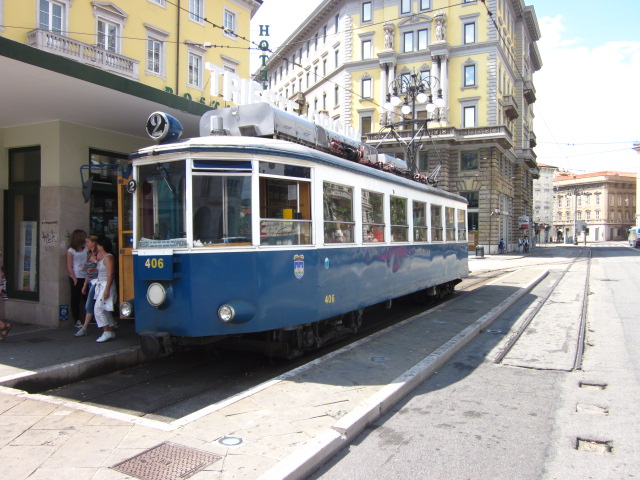
Opicina Tram
It was a good choice. Not only were the views good, but the tram was something of an antique as well. And the line itself was a bit of a curious, unique treasure. It turns out that the tram starts off on level ground and travels up a soft incline for a bit. Then, it attaches itself to some sort of tractor, which pulls the tram up a steep section of track by means of a cable. It kind of reminded me of an old carnival ride. Once on top of the incline, the tram detaches itself from the tractor and continues up into the hills above Trieste by itself. I know all this sounds a bit dull, but it really is quite a fun and charming experience. And it was good to understand how the line actually worked--really, it was nothing like the Italian description sent to Anna to translate. So I got peace of mind and lovely views to boot.

The steep bit.

Opicina.

Lovely View.
Back in Trieste, we walked up the hill to San Giusto, an old Roman forum and church. Some stoners played a monotonous tune on the bongos in the forum, and we climbed the bell tower for some magnificent views of the city.

San Giusto forum


We ended the day with an aperitivo (my favorite thing about Italy!) and a pizza dinner, followed by a trip to a character-filled bar for digestivi. Ahh Christ, if only I could do this every day.

Sweet Gesu di prosciutto.


The next day Anna planned to take me north out of town to the coast, where there were a couple of castles and a lovely sea walk. It took a while to get there by bus, but we passed through several cute, quaint Slovene villages, any of which I would gladly retire to this instant and live out the remainder of my days gardening.
We got off somewhere off the main road and headed up through the forest to the coast path, which traversed the top of the sea cliffs. The coast along the northern Adriatic consists of high cliffs due to the geology of the area; here the Karst mountains with their sharp limestone formations meet the Adriatic, and the result is a vegetated moonlike landscape with hidden caves and sharp drops. Indeed, the edges of some rocks will cut you if you are not careful while climbing on them. It really is a unique mix of nature, and the views along the walk are to die for. Well, I'll let you see for yourself:


Duino Castle.


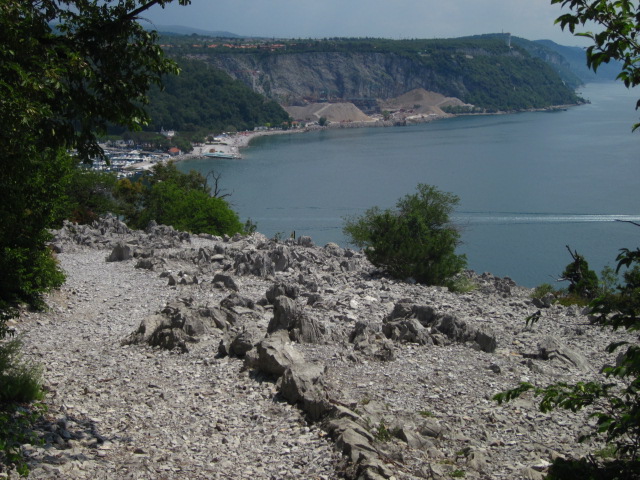

Further on, we took a bus to Castello di Miramare, built by Maximilian I about 150 years ago. The castle and the grounds are now a national park, due to the diverse flora and fauna found there, as well as the aforementioned Karst rock formations, which are extended into the sea here and create something of a unique marine environment for sea life. In addition to the picturesque grounds, the views here are fantastic as well, and although it wasn't particularly hot, the clarity of the water left me wanting to swim.

Castello di Miramare


Back in Trieste, we indulged in a sandwich and a caffé corretto (an absolutely wonderful beverage) and mosied around town for a while. Later, we went out for aperitivi with all of Anna's friends, and ate a midnight pasta dinner at Cili's apartment. Leaving everyone later that night, it was a heartfelt goodbye for Anna.
The next day our flight was at 3, so we were in no rush to get up. I woke up at 9 and turned to bother Anna as usual, when the bed started shaking softly.
"Do you feel the bed shaking?" I asked. The windchime in the hall began to tinkle, despite the windows being closed.
"Yes." I thought about the huge stone building we were in--not just an apartment building made of stone but a city block.
"That's an earthquake," I said. It shook for about 15 more seconds before it stopped. "That's an earthquake," I said, recalling the sensation I felt last summer on Fire Island as a result of the Virginia quake. "Ask your friends to check the news and see what happened. That was big somewhere." Turns out it was the most recent quake in Modena, over 300 km away from Trieste, which killed 16 and injured over 200. Big earthquake. Makes you realize how feeble everything is and how much we are at the mercy of nature. I feel bad for those who were on top of it.
In the airport, we had one last caffé (corretto for me:) before going home. I always say "Come on amore, andiamo in Italia!", but Anna says "Amore, Bormio is not Italy, you don't know Italy." Trieste may not be much more representative of Italy than Bormio, but it made me love Italy even more. I miss it.

Ciao, ragazzi.

Saturday, May 19, 2012
Notes from a Small Island
As some of you may know by now, I have recently left Mile End behind (since I don't have to go to QM anymore) and relocated to North London. It's been a welcome change of atmosphere to escape the chicken shop-and-council house runway that is East London; here there are quiet, tree-lined streets and a plethora of shops, pubs, restaurants, cinemas, and parks, as well as a good deal more cultural variety. The high street where most of these amenities are is not only the scuzziest, most hideous, and crowded avenue I've ever seen, but also seems to have the world's largest collection of ugly people. Nonetheless, it is nice to have everything within a 5 minute walk, and to be able to have Turkish whenever I want (and their extra mezzes for ordering in Turkish), open-air produce markets, and Polish shops on every other block.

Another nice thing about the high street is that there are about four charity shops, or thrift stores as we call them Stateside. One thing I truly missed about the States when I first came here was the lack of charity shops. Apparently, however, I had been looking in the wrong places--they abound in this country, and are just as bursting with delightful odds and ends to be had at low prices as their American cousins. I do love a good charity shop. The best one I have ever been to was a Salvation Army in Newark I used to frequent when I was an undergrad. For some reason, it always had the best collection of quality, stylish clothes, and I still have some of the clothes I bought there--the pants I'm wearing right now, actually. Anyway, I was tickled to find there was no shortage of charity shops in the new 'hood.
Last week I finished the remainder or my semester assessments, which finally gave me some free time for the first time since September. For nine months now I've wanted to read a book for pleasure, one which doesn't involve theory or tables and figures and all of those dreadfully boring bits that abound in academic texts, so now I finally had some time to read for myself. I had brought some books with me from home when I came here, but a look at my bookshelf left me feeling uninspired. I remembered from my mother and sister's visit that the charity shops on the high street we popped into on a rainy day seemed to have a good mix of books, so I decided to investigate. The Oxfam, the UK's equivalent to the States' Salvation Army, appeared to have a good selection, so I rolled up my socks and braved the high street crowd.
Browsing the bookshelf, I came across a tattered copy of Bill Bryson's Notes from a Small Island, a travelogue in which he documents his journey around Britain via public transport about sixteen years ago. I kind of like Bill Bryson, I thought, and I live in the UK, so I'll have a read and see what the chap has to say about this country.
Bryson's repertoire generally consists of either travelogues or those sort of books that are packed full with quirky miscellaneous facts--as well as some factual errors--about nearly everything. Indeed, A Short History of Nearly Everything is authored by him. Critically, I would say that he is, for some reason, either loved or loathed by readers. Personally, I've enjoyed other stuff I've read by him, so I thought, why not.
Although in Notes Bryson is not as nearly as curmudgeon-y or scathing as Paul Theroux is in his travelogues, I wouldn't put the two authors in separate classes. He makes broad, rash generalizations of a place he's never been before based on his experience in a visit of several hours (but then, who of us doesn't?); he is easily offended and frequently belittles the locals; and his descriptions of places are rather redundant (he describes no less than eight different places as "fetching"). However, his quirky, innocent sense of humor and the way he appreciates the smallest things with childlike wonder make the book readable. One other thing I like about Bryson is his inclusion of--surprise!--interesting bits of trivia and fascinating little-known facts about the places he visits in his writing. It spices up what would otherwise read as a pensioner's holiday tour of backwater Britain.
However, the thing I like most about Notes is Bryson's observations of the English. As he's lived in the UK for more than 20 years and counting, his assessments are far from arbitrary--he's spot on according to my experience, and describes the strange nuances of the English in a comical but endearing way. I found myself chuckling in agreement with many of these observations, although I wonder what an English person would make of all it. I'm sure though that if they did have an opinion about it, they would keep it to themselves and harbor a quiet, raging grudge against Bryson until their dying days (another truism of the English Bryson points out), probably because they'd hate to admit he's right. The English know what they are all about, but they hate it when it comes from a foreigner (note that when I say 'the English' I mean English). Once, out on a tipsy evening in a dim pub with some of my English classmates, I said to them, "What is wrong with you people? You won't open up until you have about 9 pints in you, you're too polite for your own damn good, and unless you're on holiday you're miserable. Not to mention you hate yourselves as well." Looking into their glasses with this argument laid clearly before their drunken logic, they agreed--"Yeah, it's true,"--but not without adding a grumbling "...bloody Americans..." rant before downing the final dregs of Guinness in their glasses. That's one other thing about the English--they're always going on about us being "bloody Americans", but they sure do love the States; almost all of them have been on holiday someplace in America, and they loved it.
But anyway, I'll leave the cultural stereotypes to Bryson. Looking at the back cover of Notes the other day, I saw a picture of Bryson in the corner, bushy-bearded and smiling happily. Although it was only a head shot, he looked like a big gruff Oregon lumberjack, someone who was barrel-chested and had a booming, hearty, jovial laugh. I wondered what his voice sounded like, to see if he was like the image I had formed in my head about him from his words and picture. Doesn't that ever happen to you? You see someone's photo and you want to know what their voice sounds like, how they talk? I headed over to YouTube to see if I could find a video of the guy giving an interview or something about one of his books.
I found what I was looking for, but the real-life Bryson I found could in no way be the same one who I followed around England, up the Appalachian Trail, and who taught me the history of various slices of Americana; he was rather mid-mannered and soft-spoken, with an accent that was a butchered mix of middle America and RP. I wasn't sure if this was just for show or the result of living in England for so long, but it irritated me a bit, seeing as how he's always going on about being American and whatnot in the book. Anyway, my search also found a recent BBC documentary he narrated about litter in Britain. Highlighting how Britain's countryside risks being choked by an increasing tide of garbage by its piggish and lazy citizens, it was depressing. Even worse, it was lucidly factual. You'd think that a modern industrialized country, one known for punctuality, precision, and organization, would have clean streets and forests and a slue of laws coercing people to put their trash in the bin and recycle, but this is not the case in Britain. Maybe it's because I've been in the biggest city for most of my time here, but I can vouch for the copious, disgraceful amounts of litter that defile the environment in this country, as well as the lazy ignorance of people who don't put their rubbish in the bin. Now I know America is not the cleanest place either, but I think it is much worse here. You wouldn't believe the amount of people on public transport who just throw trash right on the ground or leave it on the seat, just like that in front of everyone, or toss things right on the sidewalk. I've never seen such carelessness and ignorance. And it's a problem that goes beyond the Tube car or High street sidewalk. Dumping, known here as 'flytipping', is an equally serious problem. Near our house is a set of stairs that leads to the main road, with a trash can at the bottom. Every time you pass by, there is a huge pile of garbage spewing out of the can and into the nearby bushes. The poor garbagemen ('binmen') always clean this up, but across the sidewalk there is a metal fence, on the other side of which resides a mountain of garbage, which is never cleaned up. It's sick. And it seems everywhere in London you find a green spot, if you look closer you'll see it's full of rubbish. I can't say this about every borough, of course (Haringey, where I live now, is particularly dirty), but it is nonetheless a common feature across the city. It's hard to say whose fault all of this is. It could be blamed on the local councils: litterers and flytippers are, if caught, almost never fined, and across the city and Underground system it is almost impossible to find a trash can (or 'rubbish bin', as they are known here). However, I'm inclined to blame people just as equally. When we were searching for flats last year and this year, we were shocked at the state of some of the flats we saw. In some of them, I couldn't believe that people were actually living in them: grubby linoleum, moldy bathrooms, greasy kitchens, counters encrusted with food, and furnishings and shelving halfheartedly tacked together. In one place, two rooms had been made from one by putting up a few 2x4s, tacking drywall to them, and cutting a hole in the middle for a door, the frame of which was supported by staples. The adjacent wall to the door of this 'room' was in fact a sliding glass door to a garbage-filled patio which didn't close all the way. They wanted £500 per month. You'd think that if you were renting the place out you would try to make it halfway decent looking, a quick paint job, maybe clean the place up a little. But no. Almost all of the places we saw were dirty and grubby. In retrospect, I suppose that the last place we lived in we broke our own rules and took the place simply because it was newly renovated and fairly clean, the first and only one we saw. Nevermind that our live-in landlords were arbitrarily picky nutjobs who directed their marital misery towards us. But anyway, the domestic practice of accumulating garbage in your house and yard and not cleaning appears to be widespread in this country. Of course, this may be because the properties are rental properties, which generally tend to be scuzzy, but I can't say for sure because I've never been in a proper English home for comparison. That'll be a cold day in hell when that happens, because these people are so guardedly introverted. But you know, how hard is it to clean up a bit? When I lived in Istanbul, it was equally disgusting--the streets were flooded with rubbish because, like here, there were no bins and there was always a binman to come round and clean up after people. However, when you stepped into a Turkish home, rental or not, it was immaculate. I'm sure family homes were so clean because the women never worked and stayed at home all day in domestic servitude, but even the empty rental places I looked at were fairly well kept and, if you wanted, you could ask the landlord to fix X and install Y and it would be done, no problem. Because of this, and as counterintuitive as it may seem if you've visited Istanbul, I would have to say that Turks are cleaner than the English (by a small margin, of course).
But then again, I'm sure the last thing these people want is an American's opinion about them, and in the end maybe that's why so many people are quick to loathe Bryson.

The aforementioned tree-lined street where I now live
Another nice thing about the high street is that there are about four charity shops, or thrift stores as we call them Stateside. One thing I truly missed about the States when I first came here was the lack of charity shops. Apparently, however, I had been looking in the wrong places--they abound in this country, and are just as bursting with delightful odds and ends to be had at low prices as their American cousins. I do love a good charity shop. The best one I have ever been to was a Salvation Army in Newark I used to frequent when I was an undergrad. For some reason, it always had the best collection of quality, stylish clothes, and I still have some of the clothes I bought there--the pants I'm wearing right now, actually. Anyway, I was tickled to find there was no shortage of charity shops in the new 'hood.
Last week I finished the remainder or my semester assessments, which finally gave me some free time for the first time since September. For nine months now I've wanted to read a book for pleasure, one which doesn't involve theory or tables and figures and all of those dreadfully boring bits that abound in academic texts, so now I finally had some time to read for myself. I had brought some books with me from home when I came here, but a look at my bookshelf left me feeling uninspired. I remembered from my mother and sister's visit that the charity shops on the high street we popped into on a rainy day seemed to have a good mix of books, so I decided to investigate. The Oxfam, the UK's equivalent to the States' Salvation Army, appeared to have a good selection, so I rolled up my socks and braved the high street crowd.
Browsing the bookshelf, I came across a tattered copy of Bill Bryson's Notes from a Small Island, a travelogue in which he documents his journey around Britain via public transport about sixteen years ago. I kind of like Bill Bryson, I thought, and I live in the UK, so I'll have a read and see what the chap has to say about this country.
Bryson's repertoire generally consists of either travelogues or those sort of books that are packed full with quirky miscellaneous facts--as well as some factual errors--about nearly everything. Indeed, A Short History of Nearly Everything is authored by him. Critically, I would say that he is, for some reason, either loved or loathed by readers. Personally, I've enjoyed other stuff I've read by him, so I thought, why not.
Although in Notes Bryson is not as nearly as curmudgeon-y or scathing as Paul Theroux is in his travelogues, I wouldn't put the two authors in separate classes. He makes broad, rash generalizations of a place he's never been before based on his experience in a visit of several hours (but then, who of us doesn't?); he is easily offended and frequently belittles the locals; and his descriptions of places are rather redundant (he describes no less than eight different places as "fetching"). However, his quirky, innocent sense of humor and the way he appreciates the smallest things with childlike wonder make the book readable. One other thing I like about Bryson is his inclusion of--surprise!--interesting bits of trivia and fascinating little-known facts about the places he visits in his writing. It spices up what would otherwise read as a pensioner's holiday tour of backwater Britain.
However, the thing I like most about Notes is Bryson's observations of the English. As he's lived in the UK for more than 20 years and counting, his assessments are far from arbitrary--he's spot on according to my experience, and describes the strange nuances of the English in a comical but endearing way. I found myself chuckling in agreement with many of these observations, although I wonder what an English person would make of all it. I'm sure though that if they did have an opinion about it, they would keep it to themselves and harbor a quiet, raging grudge against Bryson until their dying days (another truism of the English Bryson points out), probably because they'd hate to admit he's right. The English know what they are all about, but they hate it when it comes from a foreigner (note that when I say 'the English' I mean English). Once, out on a tipsy evening in a dim pub with some of my English classmates, I said to them, "What is wrong with you people? You won't open up until you have about 9 pints in you, you're too polite for your own damn good, and unless you're on holiday you're miserable. Not to mention you hate yourselves as well." Looking into their glasses with this argument laid clearly before their drunken logic, they agreed--"Yeah, it's true,"--but not without adding a grumbling "...bloody Americans..." rant before downing the final dregs of Guinness in their glasses. That's one other thing about the English--they're always going on about us being "bloody Americans", but they sure do love the States; almost all of them have been on holiday someplace in America, and they loved it.
But anyway, I'll leave the cultural stereotypes to Bryson. Looking at the back cover of Notes the other day, I saw a picture of Bryson in the corner, bushy-bearded and smiling happily. Although it was only a head shot, he looked like a big gruff Oregon lumberjack, someone who was barrel-chested and had a booming, hearty, jovial laugh. I wondered what his voice sounded like, to see if he was like the image I had formed in my head about him from his words and picture. Doesn't that ever happen to you? You see someone's photo and you want to know what their voice sounds like, how they talk? I headed over to YouTube to see if I could find a video of the guy giving an interview or something about one of his books.
I found what I was looking for, but the real-life Bryson I found could in no way be the same one who I followed around England, up the Appalachian Trail, and who taught me the history of various slices of Americana; he was rather mid-mannered and soft-spoken, with an accent that was a butchered mix of middle America and RP. I wasn't sure if this was just for show or the result of living in England for so long, but it irritated me a bit, seeing as how he's always going on about being American and whatnot in the book. Anyway, my search also found a recent BBC documentary he narrated about litter in Britain. Highlighting how Britain's countryside risks being choked by an increasing tide of garbage by its piggish and lazy citizens, it was depressing. Even worse, it was lucidly factual. You'd think that a modern industrialized country, one known for punctuality, precision, and organization, would have clean streets and forests and a slue of laws coercing people to put their trash in the bin and recycle, but this is not the case in Britain. Maybe it's because I've been in the biggest city for most of my time here, but I can vouch for the copious, disgraceful amounts of litter that defile the environment in this country, as well as the lazy ignorance of people who don't put their rubbish in the bin. Now I know America is not the cleanest place either, but I think it is much worse here. You wouldn't believe the amount of people on public transport who just throw trash right on the ground or leave it on the seat, just like that in front of everyone, or toss things right on the sidewalk. I've never seen such carelessness and ignorance. And it's a problem that goes beyond the Tube car or High street sidewalk. Dumping, known here as 'flytipping', is an equally serious problem. Near our house is a set of stairs that leads to the main road, with a trash can at the bottom. Every time you pass by, there is a huge pile of garbage spewing out of the can and into the nearby bushes. The poor garbagemen ('binmen') always clean this up, but across the sidewalk there is a metal fence, on the other side of which resides a mountain of garbage, which is never cleaned up. It's sick. And it seems everywhere in London you find a green spot, if you look closer you'll see it's full of rubbish. I can't say this about every borough, of course (Haringey, where I live now, is particularly dirty), but it is nonetheless a common feature across the city. It's hard to say whose fault all of this is. It could be blamed on the local councils: litterers and flytippers are, if caught, almost never fined, and across the city and Underground system it is almost impossible to find a trash can (or 'rubbish bin', as they are known here). However, I'm inclined to blame people just as equally. When we were searching for flats last year and this year, we were shocked at the state of some of the flats we saw. In some of them, I couldn't believe that people were actually living in them: grubby linoleum, moldy bathrooms, greasy kitchens, counters encrusted with food, and furnishings and shelving halfheartedly tacked together. In one place, two rooms had been made from one by putting up a few 2x4s, tacking drywall to them, and cutting a hole in the middle for a door, the frame of which was supported by staples. The adjacent wall to the door of this 'room' was in fact a sliding glass door to a garbage-filled patio which didn't close all the way. They wanted £500 per month. You'd think that if you were renting the place out you would try to make it halfway decent looking, a quick paint job, maybe clean the place up a little. But no. Almost all of the places we saw were dirty and grubby. In retrospect, I suppose that the last place we lived in we broke our own rules and took the place simply because it was newly renovated and fairly clean, the first and only one we saw. Nevermind that our live-in landlords were arbitrarily picky nutjobs who directed their marital misery towards us. But anyway, the domestic practice of accumulating garbage in your house and yard and not cleaning appears to be widespread in this country. Of course, this may be because the properties are rental properties, which generally tend to be scuzzy, but I can't say for sure because I've never been in a proper English home for comparison. That'll be a cold day in hell when that happens, because these people are so guardedly introverted. But you know, how hard is it to clean up a bit? When I lived in Istanbul, it was equally disgusting--the streets were flooded with rubbish because, like here, there were no bins and there was always a binman to come round and clean up after people. However, when you stepped into a Turkish home, rental or not, it was immaculate. I'm sure family homes were so clean because the women never worked and stayed at home all day in domestic servitude, but even the empty rental places I looked at were fairly well kept and, if you wanted, you could ask the landlord to fix X and install Y and it would be done, no problem. Because of this, and as counterintuitive as it may seem if you've visited Istanbul, I would have to say that Turks are cleaner than the English (by a small margin, of course).
But then again, I'm sure the last thing these people want is an American's opinion about them, and in the end maybe that's why so many people are quick to loathe Bryson.
Saturday, May 12, 2012
Family
Now that I'm finished school (except for my thesis), I finally have more
time to devote to the blog. Some of the family came to visit me a few
weeks ago, didn't take many photos but here's a few I managed to sneak
in.
Most of the week was spent in London, but we did make it down to Brighton one day.


The weather did behave somewhat on the last day of their visit, and we got to walk up to Ally Pally to enjoy the view.


Most of the week was spent in London, but we did make it down to Brighton one day.

The weather didn't disappoint.

This actually happened once...but about fifteen years ago.


Only one thing to do on a wet spring day in Brighton...

In the fishbowl.

The weather did behave somewhat on the last day of their visit, and we got to walk up to Ally Pally to enjoy the view.


Calling Dad.
Sorry guys! Next time we'll go to Devon!
Tuesday, April 10, 2012
Exeter
Now since I've been here, which is about seven months now, I haven't been outside of London. Well, I did go to Italy in September and December, but when I say I haven't been outside of London I mean I haven't been to any other part of England. One time last year I did go to Chelmsford to borrow a classmate's computer, but since that's in Essex I don't count it.
Now living in London is an embittering experience. The people are utterly miserable and impossibly reserved, it's fantastically expensive, and the weather is permanently overcast, which I wouldn't have a problem with were the people a bit friendlier. As a result of this, I have had an increasingly negative view of this country. So this Easter weekend, a holiday was definitely on the menu for us, having been relegated to work and study for 7 long months.
Since we only had a few days off and, this being London, not much cash in hand, we had to go someplace close. There are dozens of small holiday cities around southern England, and after mulling indecisively about which one to escape to, we chose Exeter in the end, as it wasn't too far, it was close to the sea, and was rumored to have a fantastically beautiful coastline. So on Friday we set off.
We weren't disappointed. Maybe it was because of the prolonged period in London, but we found Exeter to be absolutely charming. The lack of people and slower pace of things took us aback, and people were actually friendly and spoke to you.
Now if you're ignorant of English geography like myself, Exeter is a medieval city on the coast in Devon, which is in southwest England, right next to Cornwall. It's a charming county abound with lush green hills, plenty of sheep, and thatch-roof cottages. It is indeed the English countryside of your imagination.

Exeter is Devon's largest city and boasts a huge medieval cathedral, a good amount of Tudor houses several hundred years old, and a series of underground crypts and other historical gems, despite being nearly completely destroyed by Nazi air raids. We spent the first day exploring these little historical bits, and when it got gloomy and cold, we retreated to the warmth of the pub.


Well, trails are never as the crow flies, especially when you're hiking along hundred-foot cliffs and up and down combes every mile. It turns out we walked a total of about 9 miles. As we never exercise, or walk farther than the tube station, our legs were stiffer than wood at the end of the day, and we were absolutely knackered. But it was worth it. Have a look for yourself.


Although the next day we wanted to relax our legs, it was our last day, and we took a walking tour of the city and went to a museum. Being Easter Sunday, all of the shops were closed and there weren't many people. It was perfect.
A bit later, we struck up a conversation with a kind couple in the pub from Cornwall who were also on holiday here. The conversation eventually turned to London:
"Yeah, London's horrible. Everyone's so miserable. And you've got all those different nationalities there! No, we'll stay in Cornwall, thankyouverymuch." It was nice to have a real conversation with real English people.
As we left the pub to head for the bus station, the sounds of musicians playing a medieval tune and the smell of Cornish pasties drifted down the street, and I thought, "England's not so bad after all."
Now living in London is an embittering experience. The people are utterly miserable and impossibly reserved, it's fantastically expensive, and the weather is permanently overcast, which I wouldn't have a problem with were the people a bit friendlier. As a result of this, I have had an increasingly negative view of this country. So this Easter weekend, a holiday was definitely on the menu for us, having been relegated to work and study for 7 long months.
Since we only had a few days off and, this being London, not much cash in hand, we had to go someplace close. There are dozens of small holiday cities around southern England, and after mulling indecisively about which one to escape to, we chose Exeter in the end, as it wasn't too far, it was close to the sea, and was rumored to have a fantastically beautiful coastline. So on Friday we set off.
We weren't disappointed. Maybe it was because of the prolonged period in London, but we found Exeter to be absolutely charming. The lack of people and slower pace of things took us aback, and people were actually friendly and spoke to you.
Now if you're ignorant of English geography like myself, Exeter is a medieval city on the coast in Devon, which is in southwest England, right next to Cornwall. It's a charming county abound with lush green hills, plenty of sheep, and thatch-roof cottages. It is indeed the English countryside of your imagination.

Devonshire.
Exeter is Devon's largest city and boasts a huge medieval cathedral, a good amount of Tudor houses several hundred years old, and a series of underground crypts and other historical gems, despite being nearly completely destroyed by Nazi air raids. We spent the first day exploring these little historical bits, and when it got gloomy and cold, we retreated to the warmth of the pub.

Longest uninterrupted medieval nave in the world.
 Untouched by the war

On Saturday, we set out towards the real reason we came to Exeter: the Jurassic coast. Now being locked up in a concrete jungle for months on end makes one crave a bit of nature, and although London has vast, numerous parks, they're just not the same. So the Jurassic coast, which gets its name from the period in which its geological magnificence was formed, seemed like a good destination, as it is possible to walk along its cliffs and take in a good lungful of sea air while doing so. So we planned a decent hike along the coast and took the bus to the tiny fishing village of Beer (alas, no pic!!). From Beer, we had decided to walk west towards Sidmouth, about 7 miles, and then catch the bus back to Exeter. Shouldn't be too bad of a hike, we thought. Untouched by the war


Beer
Well, trails are never as the crow flies, especially when you're hiking along hundred-foot cliffs and up and down combes every mile. It turns out we walked a total of about 9 miles. As we never exercise, or walk farther than the tube station, our legs were stiffer than wood at the end of the day, and we were absolutely knackered. But it was worth it. Have a look for yourself.


Pastures are indeed part of the trail.


Although the next day we wanted to relax our legs, it was our last day, and we took a walking tour of the city and went to a museum. Being Easter Sunday, all of the shops were closed and there weren't many people. It was perfect.
A bit later, we struck up a conversation with a kind couple in the pub from Cornwall who were also on holiday here. The conversation eventually turned to London:
"Yeah, London's horrible. Everyone's so miserable. And you've got all those different nationalities there! No, we'll stay in Cornwall, thankyouverymuch." It was nice to have a real conversation with real English people.
As we left the pub to head for the bus station, the sounds of musicians playing a medieval tune and the smell of Cornish pasties drifted down the street, and I thought, "England's not so bad after all."
Subscribe to:
Posts (Atom)