We got the itch a few weeks ago, and while a quick search of Skyscanner found flights to Lamezia Terme, where our friend Roberto lives, to be too expensive, an 'aha' moment of mine revealed a bargain on flights to Trieste. So Saturday morning we packed a weekend bag, grabbed a book, and headed off to Stansted.
Now Trieste is no common tourist destination. In fact, the main reason we headed off there is because of Anna's strong connection to the place--she spent seven years there for university and as a result all of her friends are there, and it has become something of a second home for her, albeit one she never gets to visit. So after a two-hour continental flyover and a birdseye view of Venice, she was quite happy indeed to be back in Friuli Venezia Giulia, where her friend Cili was waiting for us at the airport.
The weather was gorgeous; clear and sunny and cool, nothing like the sweaty mess we left behind in London. On the way back from the airport, I rolled the window down and drank the cool, pine-scented sea air. Rolling into town along the coastal road, I immediately saw why Anna loved Trieste so much--it was a gem of a city, and a hidden one at that.
Trieste
After arriving in town, parking the car, and dumping the bag, we set out to take care of priority number one, the first thing we always do when going to Italy: sandwiches. If nothing else, the Italians do not fuck around when it comes to sandwiches (or any food, for that matter). So we found a little café around the corner, and I occupied myself with a mouthwatering
prosciutto cotto sandwich and a shotglass of beer (here the Italians lose to the Brits) while Anna caught up with her growing entourage of friends. Incidentally, the day we arrived was not only her friend Mino's birthday, but also the annual "Cherry Festival". Trieste has a large Slovenian population in the surrounding mountain villages, and every year in May there is a festival celebrating the first cherry harvest. In the past the group of friends had gone every year, so naturally, we were going that evening.
So, a few hours later, we headed up into the hills to the Praznik Češenj ("cherry festival" in Slovenian, forgot what it is in Italian), which was in a quiet little village called Mačkolje. How cute, I thought. "I'm so hungry," Anna said as we walked up after parking the car. "They have these little sausages,
civa, they're delicious." Good, I thought; that sandwich was only to hold me over for the main event, the Praznik, and I was starving.
The praznik, however, was a mob scene. Really, there must have been about 800 people queued up around the blazing, smoking grills. Oh boy. Rumor had it it was an hour's wait. Damn. Someone smart in the group had the brilliant idea that two of us would get in line to get the tickets, two would get in line for the meat, and two would get in line for the chips/cherries, and after the tickets were bought they would be passed off to those waiting in line, who would be near the front by the time the tickets were had. It was a good idea, but it still ended up being an hour's wait. And of course, Anna and I were in the meat line, which took the longest. I admit I was getting irritated being stuck in the crowd and tired of waiting, but as we got near the grill I felt more bad for the poor Slovenian folk working the grill, hot and sweaty and sooty smoke blasting into their faces.
In the end, we ended up waiting a while, but the food was delicious, and there was good beer and cherries for dessert, and we were all quite happy. And the sausages--tiny little things eaten with raw onion slices--were absolutely delicious. "You have to eat it with the onions," Cili said. "Eating
čevapčiči without onions is like...." ....well, I'll leave it to your imagination.
Praznik Češenj
The next day I was up bright and early. I wanted to get out and see the town, but Anna was in no rush. Apparently, we were meeting the others at 11 for breakfast, but no one told me. Just because I can understand Italian doesn't always mean I'm listening. That's the only thing that bothers me about going to Italy is that Anna never tells me what we are doing. She just assumes I know what we are doing and I follow her, not knowing what we are doing. However, this particular morning I whined enough to get us some sightseeing time before breakfast.
I suppose it would be appropriate here to tell a little bit about Trieste. Two hundred odd years ago, Trieste lay within the realm of the Austro-Hungarian Empire. It was the Empire's only port city and as such was established as a free port. Naturally, it prospered, and the city expanded with much of the architecture taking after cities in the interior of the Empire. The Piazza Unità d'Italia, the main square, is the largest square in Europe with one side open to the sea. There are many piers, and the structures in the town center reflect Neoclassical, Baroque, Rococo, Romanesque, and Art-Nouveau styles of architecture. Put simply, it is absolutely charming, not simply due to the architecture, but because of the combination of old-Europe style winding streets and proximity to the sea. We managed to get a good stroll in along the pier and around the town center before breakfast.
Town Hall.
Pier bum.
Reminiscent of Venice?
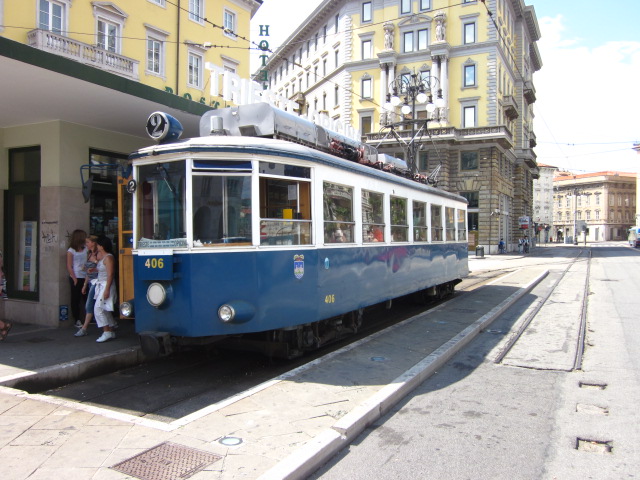
After breakfast, we debated what to do for the rest of the day. The others had prior obligations, but Anna and Evelyn--one of Anna's best friends, who had visited us in Istanbul--were going to show me around. One thing I had wanted to do while in Trieste was to ride the Opicina tram. It seems a bit trivial, but the cause for this goes back a few weeks, when I helped Anna with a translation for the Friuli Venezia Giulia tourism board; we struggled to translate properly a bit about this Opicina tramway, mainly because of all the technical terms involved and the uniqueness of the tram line itself, and while we were successful, the end result felt a bit butchered. We didn't really understand it, and I insisted we go take this tram so I could clear up the obscure descriptions in the translation in my own mind, and to sate the train-loving child within me. Plus, the description promised good views of the city and surrounding gulf. Why not.
Opicina Tram
It was a good choice. Not only were the views good, but the tram was something of an antique as well. And the line itself was a bit of a curious, unique treasure. It turns out that the tram starts off on level ground and travels up a soft incline for a bit. Then, it attaches itself to some sort of tractor, which pulls the tram up a steep section of track by means of a cable. It kind of reminded me of an old carnival ride. Once on top of the incline, the tram detaches itself from the tractor and continues up into the hills above Trieste by itself. I know all this sounds a bit dull, but it really is quite a fun and charming experience. And it was good to understand how the line actually worked--really, it was nothing like the Italian description sent to Anna to translate. So I got peace of mind and lovely views to boot.
The steep bit.
Opicina.
Lovely View.
Back in Trieste, we walked up the hill to San Giusto, an old Roman forum and church. Some stoners played a monotonous tune on the bongos in the forum, and we climbed the bell tower for some magnificent views of the city.
San Giusto forum
We ended the day with an
aperitivo (my favorite thing about Italy!) and a pizza dinner, followed by a trip to a character-filled bar for
digestivi. Ahh Christ, if only I could do this every day.
Sweet Gesu di prosciutto.
The next day Anna planned to take me north out of town to the coast, where there were a couple of castles and a lovely sea walk. It took a while to get there by bus, but we passed through several cute, quaint Slovene villages, any of which I would gladly retire to this instant and live out the remainder of my days gardening.
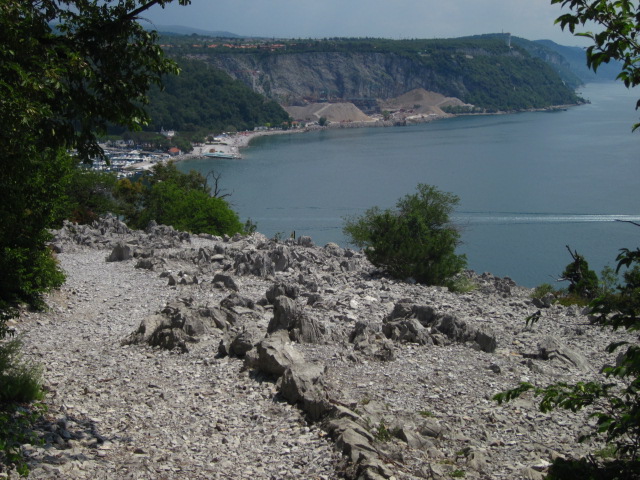
We got off somewhere off the main road and headed up through the forest to the coast path, which traversed the top of the sea cliffs. The coast along the northern Adriatic consists of high cliffs due to the geology of the area; here the Karst mountains with their sharp limestone formations meet the Adriatic, and the result is a vegetated moonlike landscape with hidden caves and sharp drops. Indeed, the edges of some rocks will cut you if you are not careful while climbing on them. It really is a unique mix of nature, and the views along the walk are to die for. Well, I'll let you see for yourself:
Duino Castle.
Further on, we took a bus to Castello di Miramare, built by Maximilian I about 150 years ago. The castle and the grounds are now a national park, due to the diverse flora and fauna found there, as well as the aforementioned Karst rock formations, which are extended into the sea here and create something of a unique marine environment for sea life. In addition to the picturesque grounds, the views here are fantastic as well, and although it wasn't particularly hot, the clarity of the water left me wanting to swim.
Castello di Miramare
Back in Trieste, we indulged in a sandwich and a
caffé corretto (an absolutely
wonderful beverage) and mosied around town for a while. Later, we went out for
aperitivi with all of Anna's friends, and ate a midnight pasta dinner at Cili's apartment. Leaving everyone later that night, it was a heartfelt goodbye for Anna.
The next day our flight was at 3, so we were in no rush to get up. I woke up at 9 and turned to bother Anna as usual, when the bed started shaking softly.
"Do you feel the bed shaking?" I asked. The windchime in the hall began to tinkle, despite the windows being closed.
"Yes." I thought about the huge stone building we were in--not just an apartment building made of stone but a city
block.
"That's an earthquake," I said. It shook for about 15 more seconds before it stopped. "That's an earthquake," I said, recalling the sensation I felt last summer on Fire Island as a result of the Virginia quake. "Ask your friends to check the news and see what happened. That was big somewhere." Turns out it was the most recent quake in Modena, over 300 km away from Trieste, which killed 16 and injured over 200. Big earthquake. Makes you realize how feeble everything is and how much we are at the mercy of nature. I feel bad for those who were on top of it.
In the airport, we had one last
caffé (
corretto for me:) before going home. I always say "Come on amore,
andiamo in Italia!", but Anna says "Amore, Bormio is not Italy, you don't know Italy." Trieste may not be much more representative of Italy than Bormio, but it made me love Italy even more. I miss it.
Ciao, ragazzi.


 When we finally reached the lake, we were absolutely knackered, but it was worth it. The lake was crystal clear, serene, deserted. Even though it was a bit chilly, I was hot from the hike up, and the water looked enticing. "It's freezing," Anna warned me. I didn't care--it looked refreshing, and besides, when was the next time I would be able to swim in an alpine lake 10,000 feet up? I hadn't come prepared to swim, but I made do.


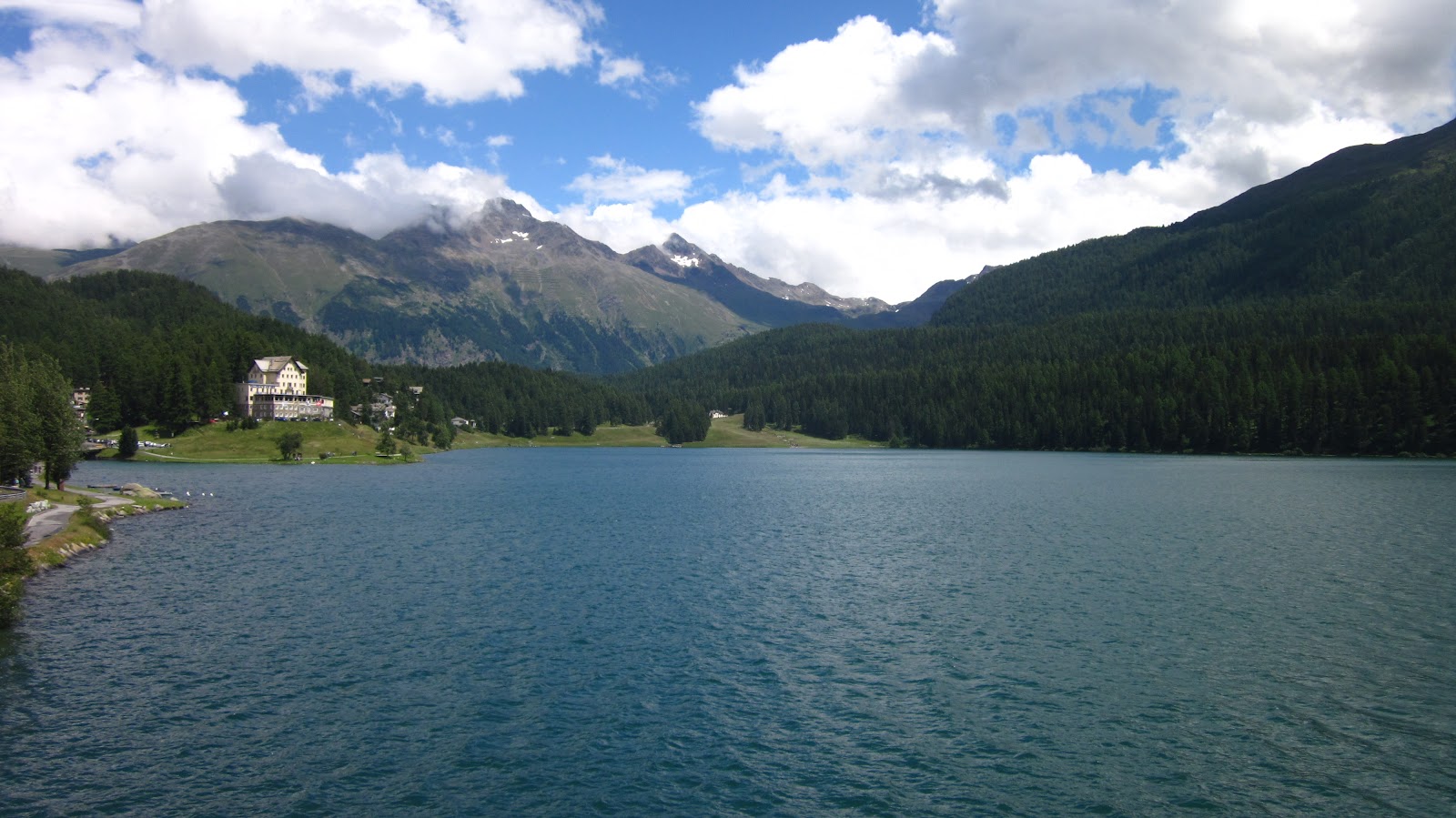
 The Bernina Express, the part of the Swiss Railway that runs between Tirano in Italy and St. Moritz in Switzerland, is actually one of three railways in the world with a UNESCO World Hertiage stamp. It sounds silly, but once you ride it and see the views it's easy to understand why. The train zigzags up over 2000 meters to pass beneath the glaciers of Piz Bernina, the highest mountain in the Eastern Alps at 4,049 meters (13,284 ft). The day we went the weather was foggy (and rainy, and snowy) around the heights of Bernina, so we didn't get to see much of the peak itself, but I wasn't bothered. Actually, I was a bit relieved; during some parts of the journey I peered out the window and felt sickeningly dizzy at the sight of the abyss hidden by the fog directly below us. However, we did have some nice views from the train, as the weather cleared up in some spots and provided a few lovely panoramas.